⚡ DISCOVERING ELECTRONS
PAGE 1 OF 5 — THE MYSTERY OF CATHODE RAYS
ELECTRICITY IN A VACUUM TUBE
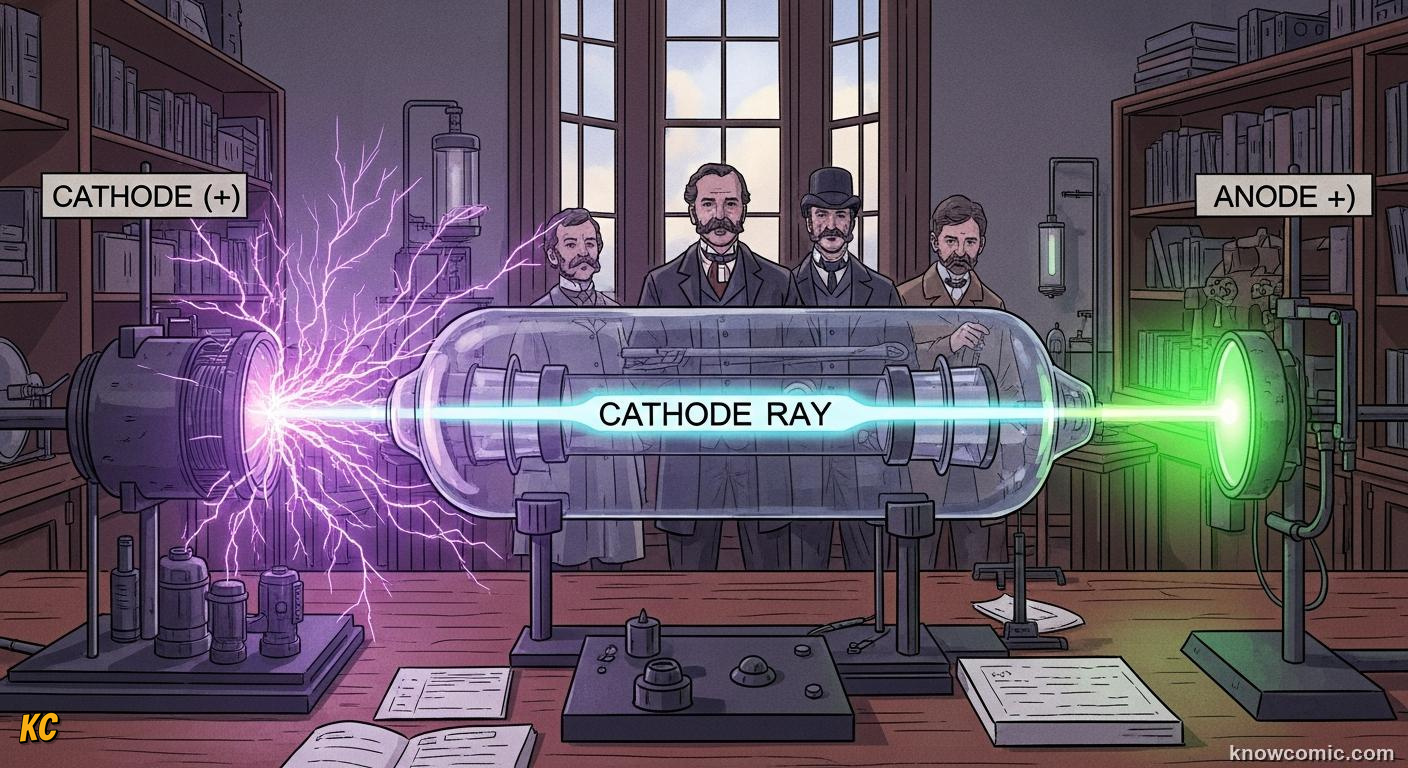
WHAT ARE CATHODE RAYS?
In the 1830s, scientists pumped almost all the air out of glass tubes and fired electricity through them. A mysterious glowing beam appeared — shooting from the negative end (cathode) to the positive end (anode). Nobody knew what this beam was made of. Was it a wave like light, or a stream of particles? The beam could be deflected by magnets and electric fields, which hinted it carried electric charge. This puzzling "cathode ray" stumped scientists for over fifty years — until one man cracked the mystery.
⚡ CATHODE RAY FACTS
Cathode rays always travel from negative (cathode) to positive (anode). They can spin a tiny paddle wheel placed in their path — proving they carry momentum.
MYSTERY!
THE CATHODE RAY TUBE
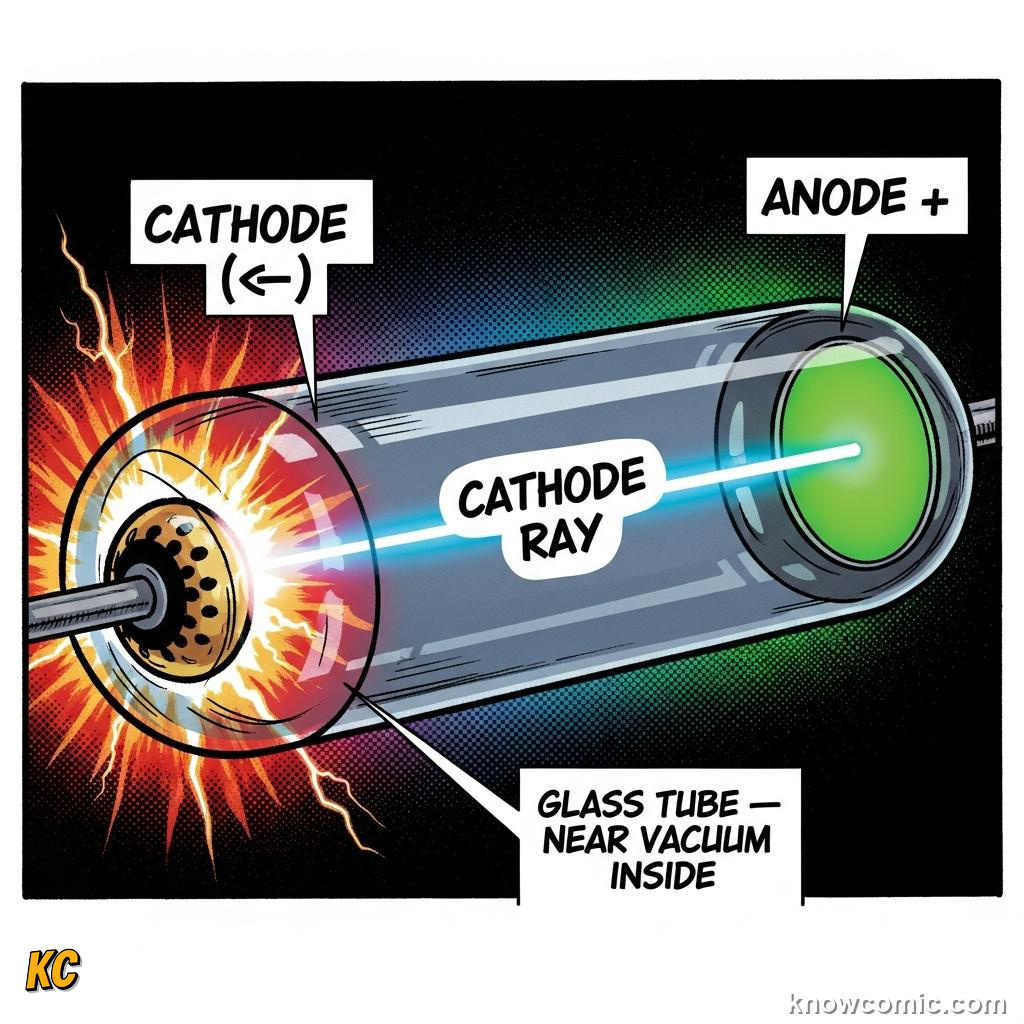
🔌 Glass tube with most air removed
⚡ Beam travels cathode → anode
🌟 Glows green on fluorescent screen
⚡ Beam travels cathode → anode
🌟 Glows green on fluorescent screen
TWO COMPETING THEORIES
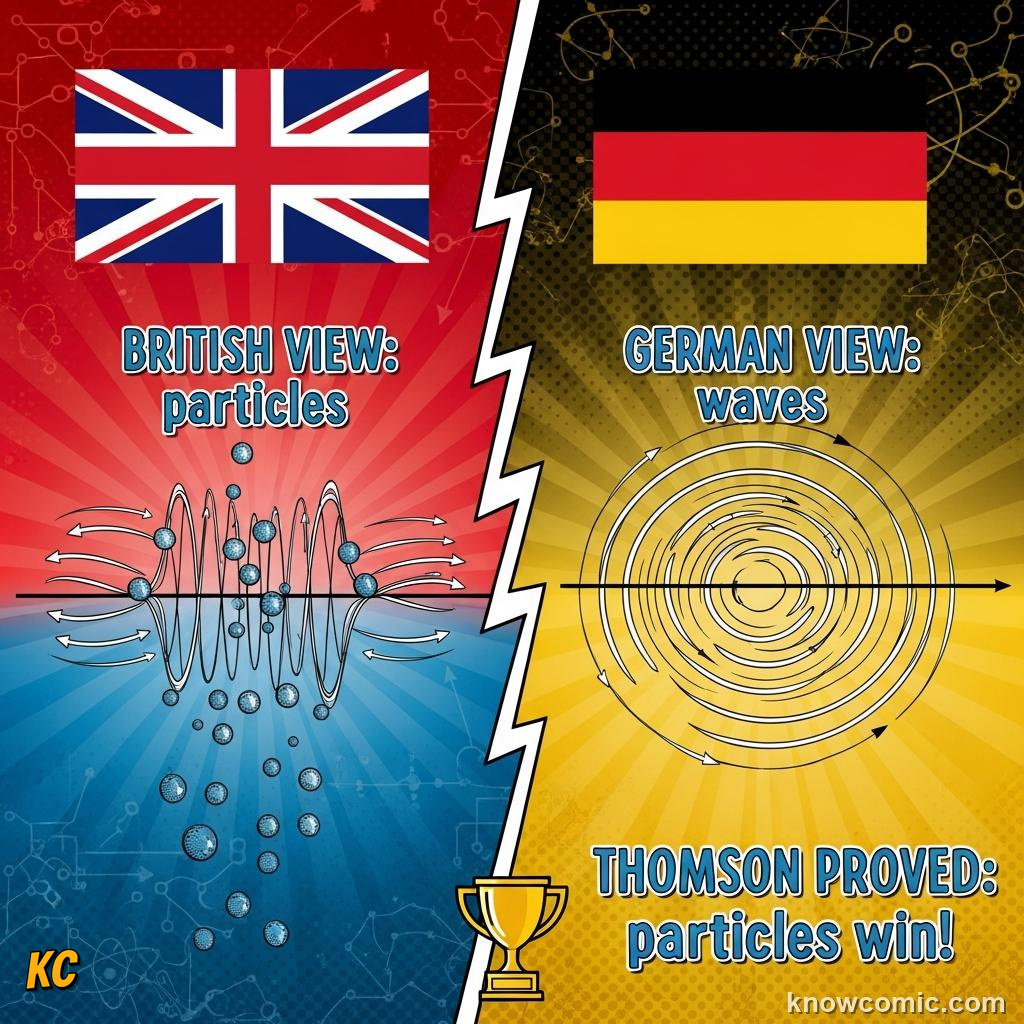
🌊 British view: rays are particles
💨 German view: rays are waves
🏆 Thomson proved: particles win!
💨 German view: rays are waves
🏆 Thomson proved: particles win!
PAGE 2 OF 5 — THOMSON'S EXPERIMENT, 1897
THE EXPERIMENT THAT CHANGED SCIENCE
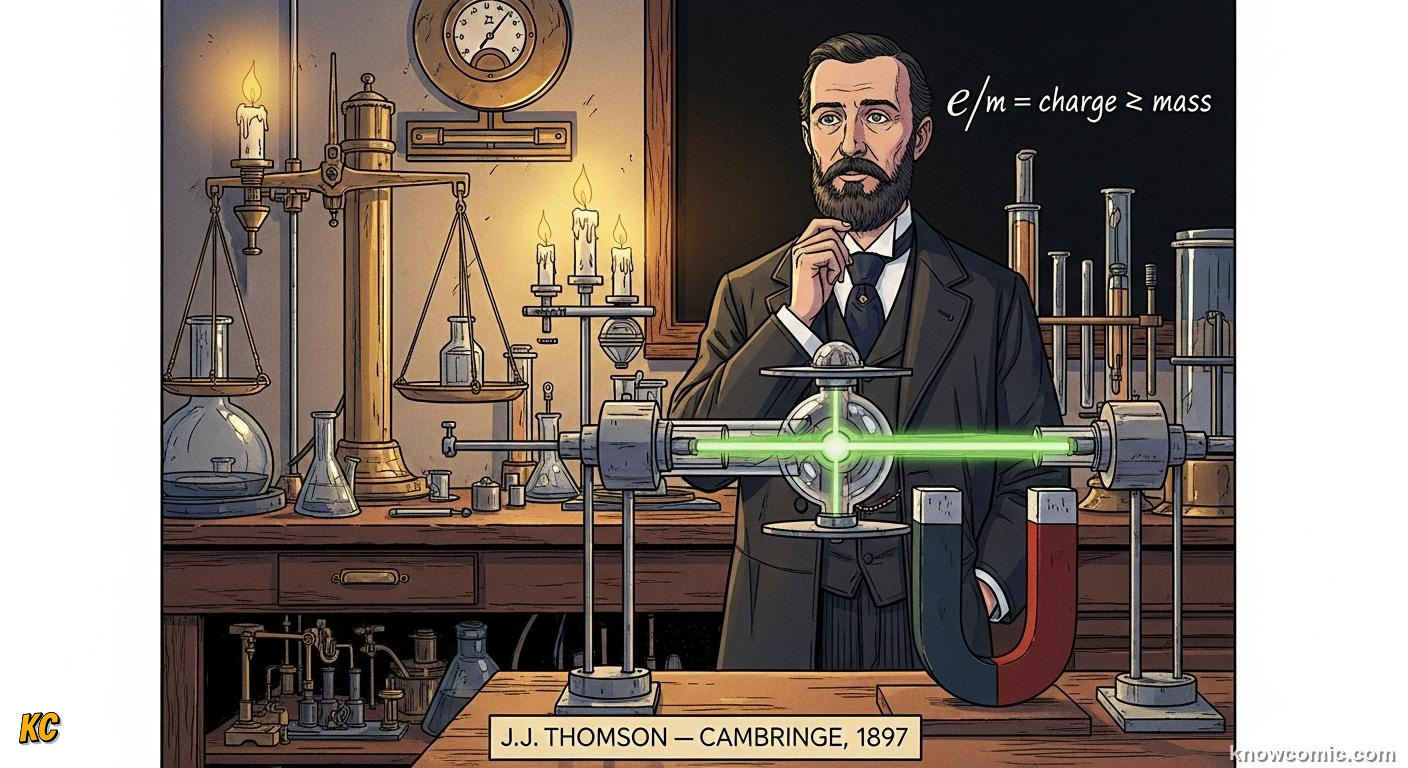
J.J. THOMSON AT CAMBRIDGE, 1897
British physicist Joseph John Thomson at Cambridge's Cavendish Laboratory set up a cathode ray tube with electric plates above and below the beam and a magnet alongside it. By carefully balancing the electric and magnetic forces on the beam, Thomson could measure exactly how much the beam bent. From these measurements, he calculated the charge-to-mass ratio of the particles in the beam. The ratio was the same no matter which metal he used for the cathode, or which gas was left in the tube. This meant the particles were universal — the same in every atom. Thomson had discovered something smaller than an atom.
🏆 NOBEL PRIZE 1906
Thomson won the Nobel Prize in Physics in 1906 for his discovery of the electron — the first subatomic particle ever identified.
DISCOVERY!
⚡ STEP 1
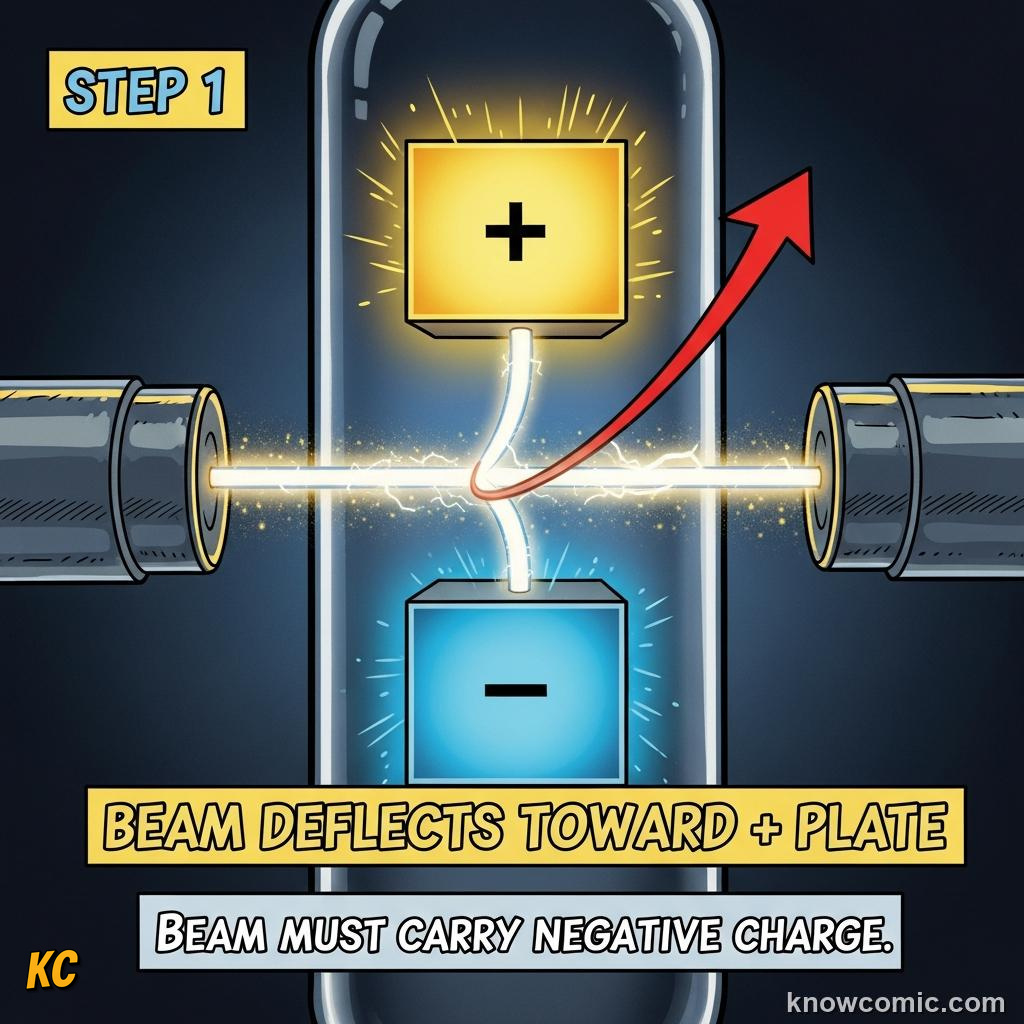
🔌 Fire beam through vacuum tube
📐 Place charged plates above and below
🔀 Beam deflects toward positive plate
📐 Place charged plates above and below
🔀 Beam deflects toward positive plate
⚡ STEP 2
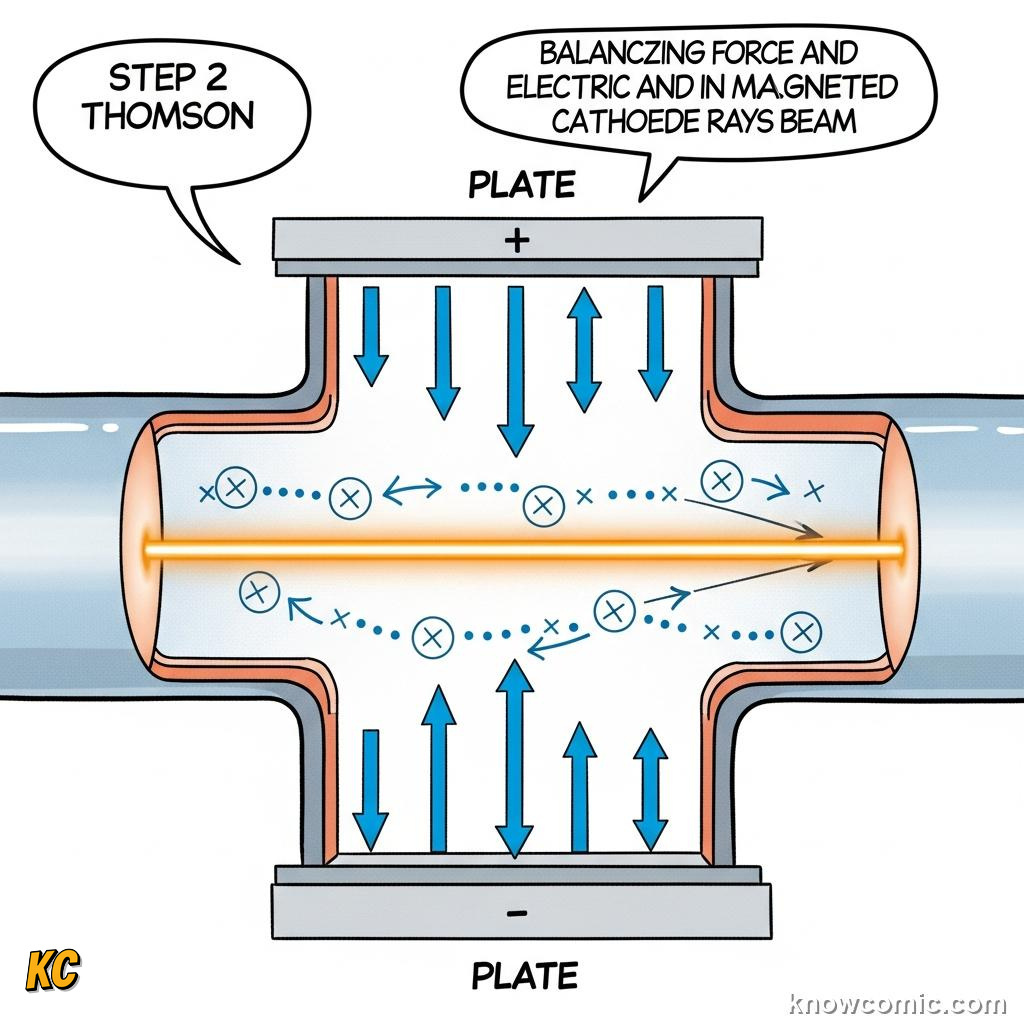
🧲 Add magnetic field to counteract
⚖️ Balance electric vs magnetic force
📏 Measure exactly how much beam bends
⚖️ Balance electric vs magnetic force
📏 Measure exactly how much beam bends
⚡ RESULT
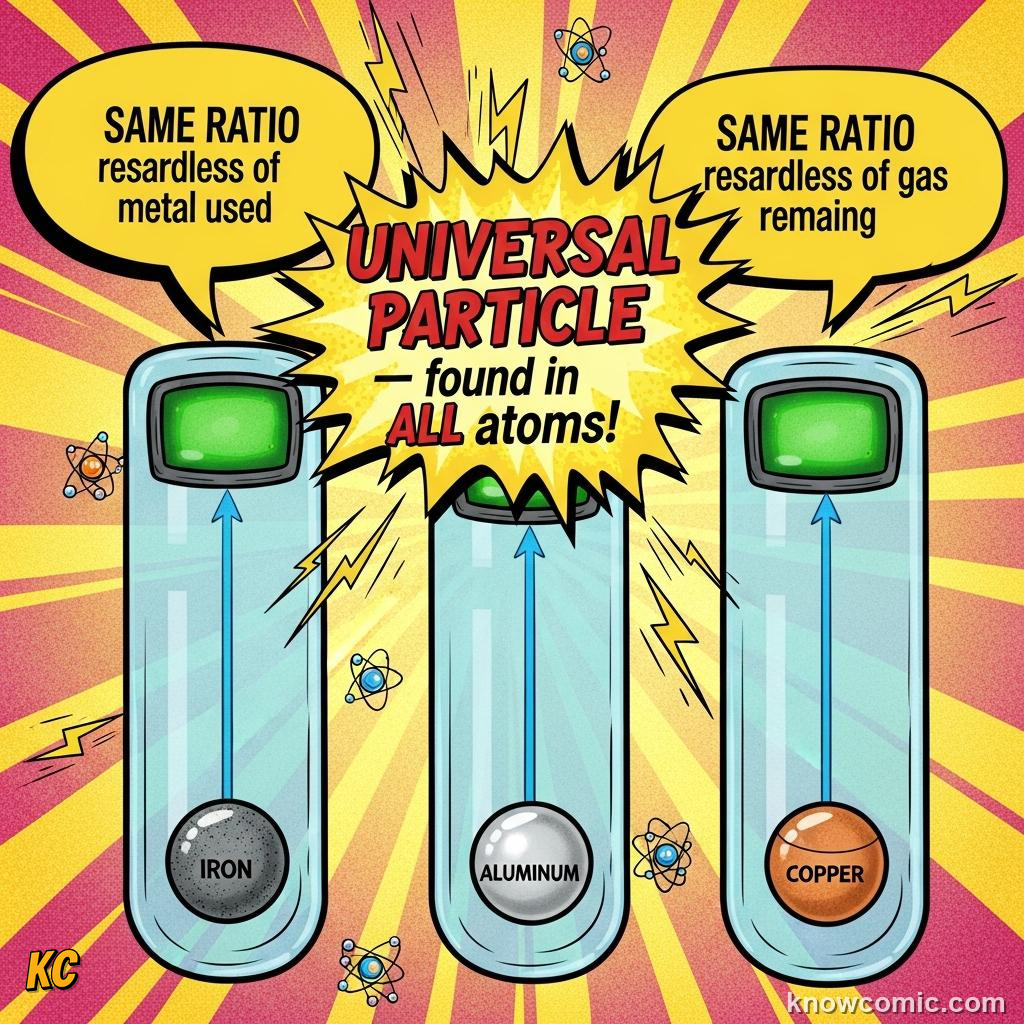
🔢 Calculate charge-to-mass ratio
🔁 Same ratio for ALL metals and gases
🎯 Universal particle — smaller than atom!
🔁 Same ratio for ALL metals and gases
🎯 Universal particle — smaller than atom!
PAGE 3 OF 5 — PROPERTIES OF THE ELECTRON
CHARGE & MASS
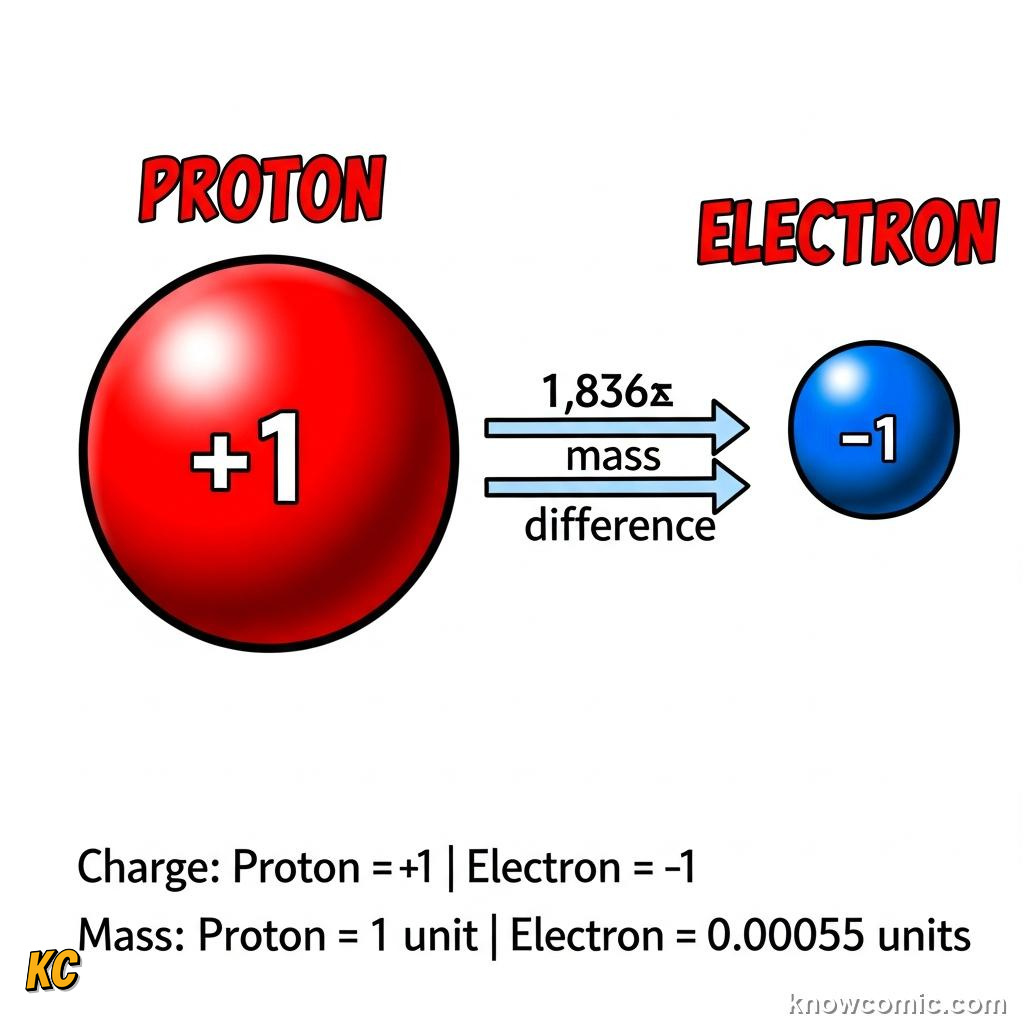
🔵 Charge: −1 (negative)
⚖️ Mass: 1/1836 of a proton
🌀 Orbits outside the atom's nucleus
⚖️ Mass: 1/1836 of a proton
🌀 Orbits outside the atom's nucleus
MILLIKAN OIL DROP 1909
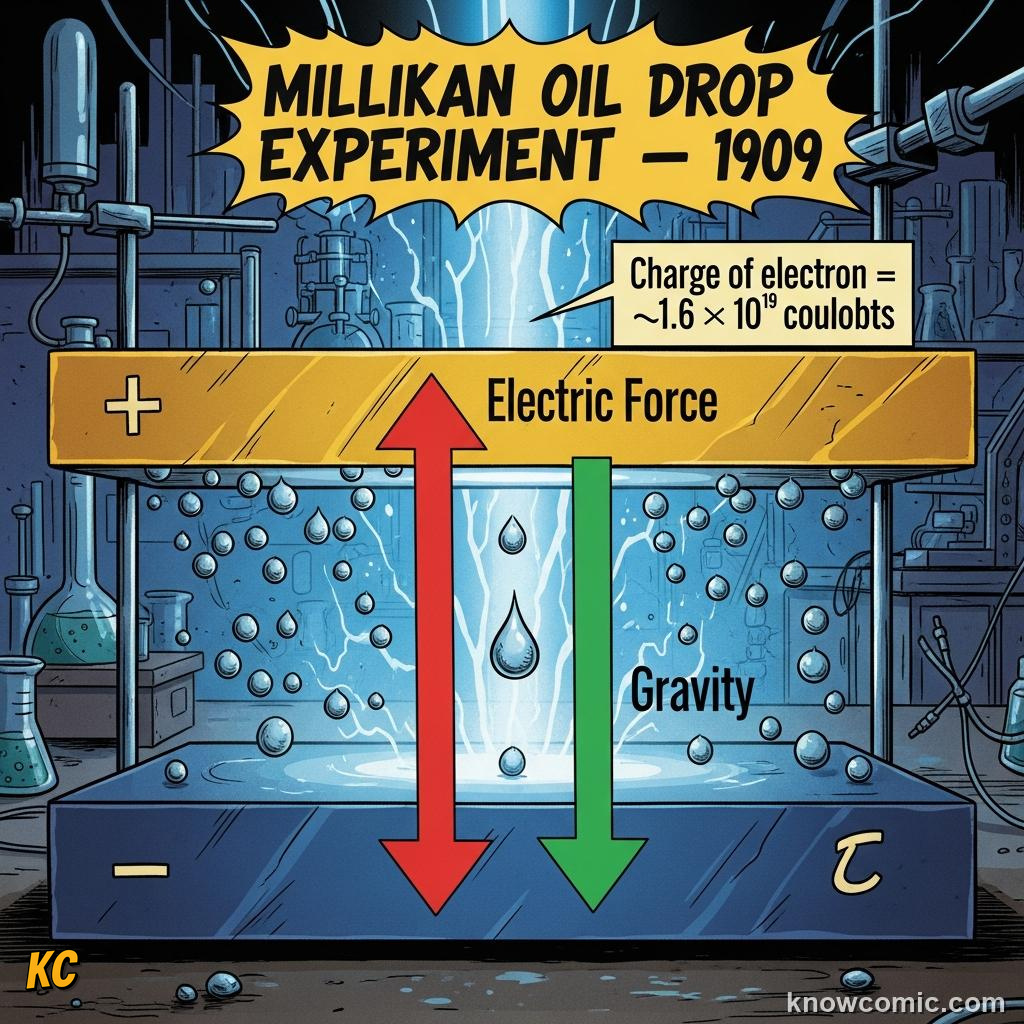
💧 Millikan measured exact charge
📐 Charge = −1.6 × 10⁻¹⁹ coulombs
🔢 Mass = 9.1 × 10⁻³¹ kilograms
📐 Charge = −1.6 × 10⁻¹⁹ coulombs
🔢 Mass = 9.1 × 10⁻³¹ kilograms
THE ELECTRON REVEALED
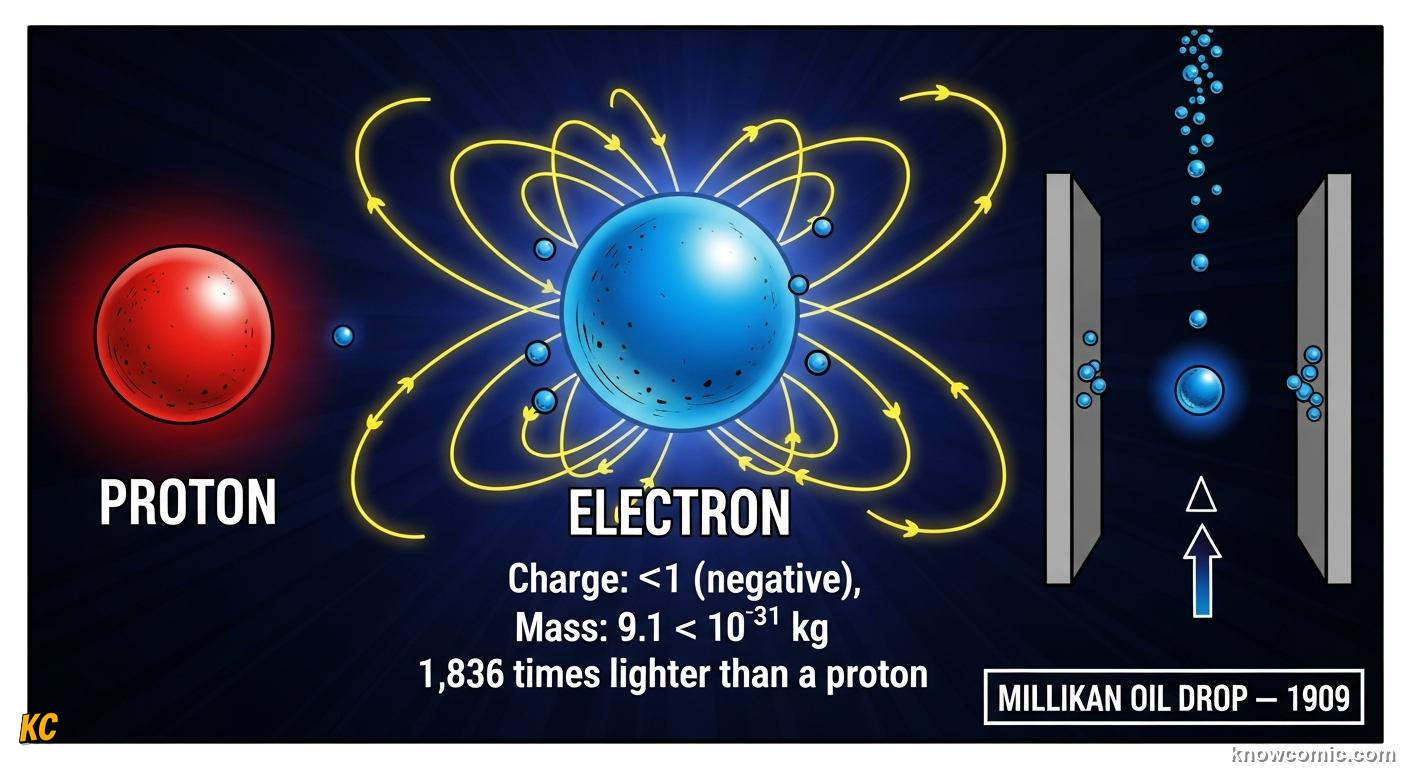
THE ELECTRON — KEY PROPERTIES
Thomson's particles were later named electrons — from the Greek elektron, meaning amber (which was known since ancient times to attract objects when rubbed). Electrons are negatively charged and incredibly tiny — about 1,836 times lighter than a proton. In 1909, American physicist Robert Millikan suspended oil drops between charged plates and precisely measured the charge of a single electron: −1.6 × 10⁻¹⁹ coulombs. This value is so fundamental to physics it is called the elementary charge. Every electron in the universe carries exactly this amount of charge — no more, no less.
🔵 ELECTRON FACTS
Electrons are not solid balls — they behave as both particles and waves. This bizarre "wave-particle duality" is the foundation of quantum mechanics.
ELECTRON!
PAGE 4 OF 5 — THE PLUM PUDDING MODEL
THOMSON'S MODEL OF THE ATOM, 1904
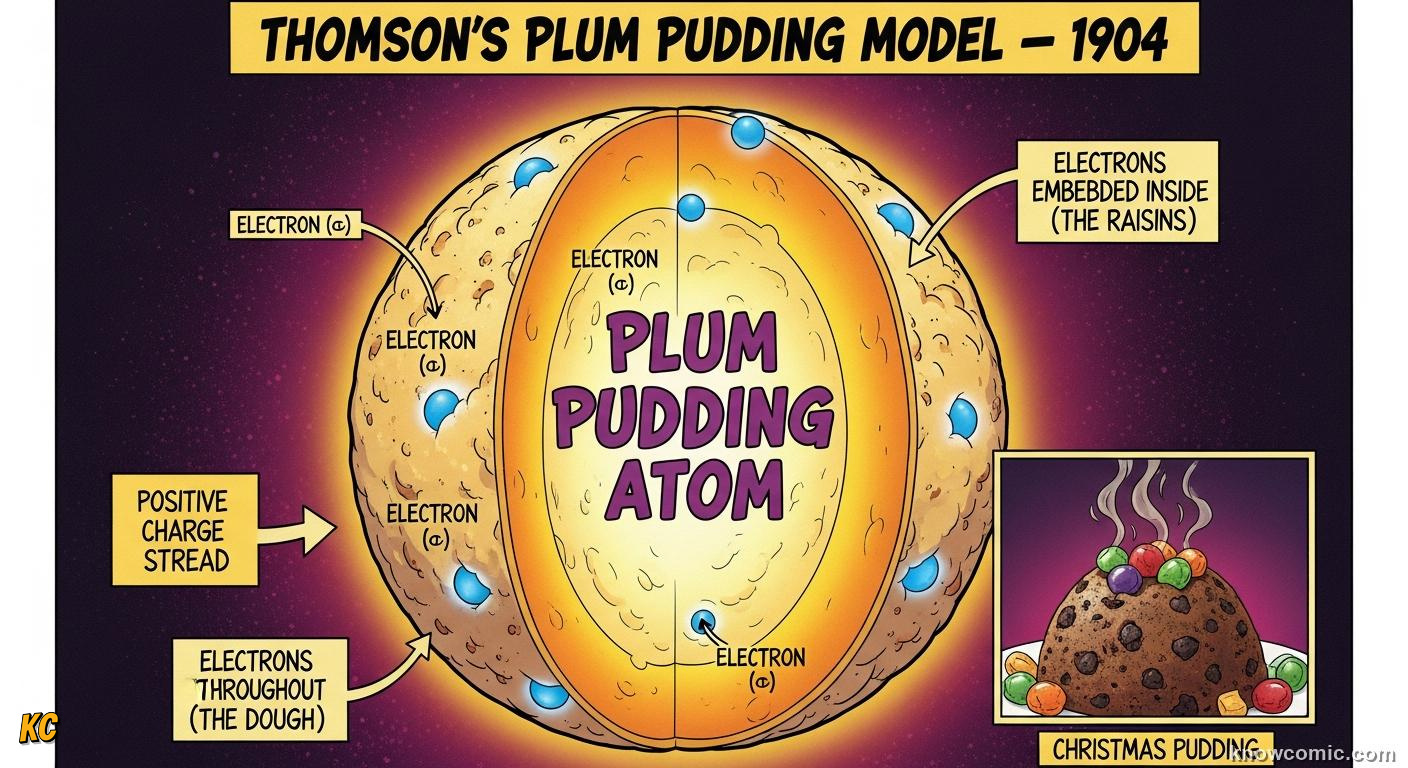
THE PLUM PUDDING MODEL
After discovering the electron, Thomson knew atoms contained negative particles — but atoms are electrically neutral overall. So where was the positive charge? Thomson proposed his "plum pudding" model in 1904: the atom was a sphere of diffuse positive charge (the dough) with tiny negative electrons embedded throughout it (like raisins in a Christmas pudding). This was the first model of atomic structure ever proposed. It was wrong — Rutherford's 1911 gold foil experiment would prove that positive charge is concentrated in a tiny nucleus — but Thomson's model was a crucial first step. Science works by proposing models and testing them.
🍮 WHY "PLUM PUDDING"?
In 1904, a British Christmas pudding (a dark dough cake with raisins inside) was the perfect analogy for a positive sphere with electrons embedded inside it.
PUDDING!
🍮 THE MODEL
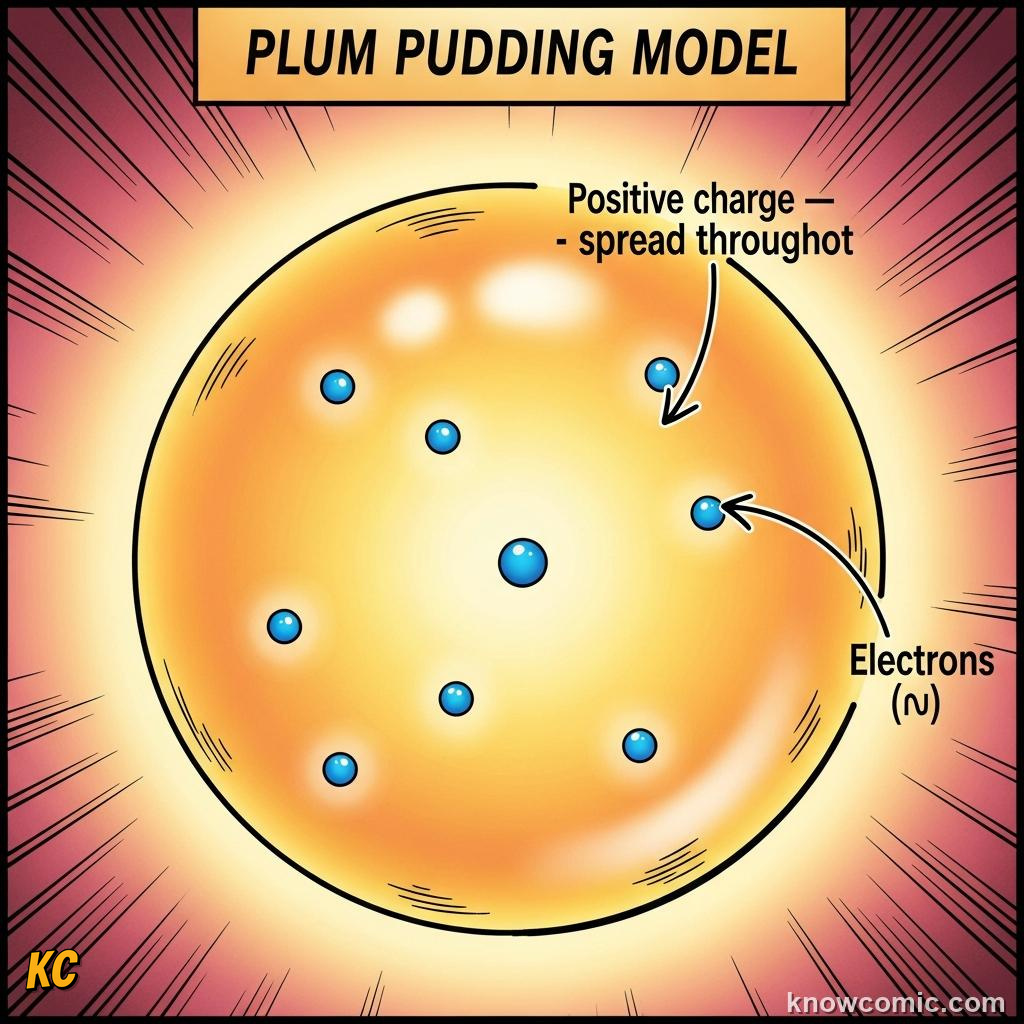
⊕ Positive charge spread throughout
🔵 Electrons embedded like raisins
⚖️ Total charge = zero (neutral atom)
🔵 Electrons embedded like raisins
⚖️ Total charge = zero (neutral atom)
✅ WHAT IT GOT RIGHT
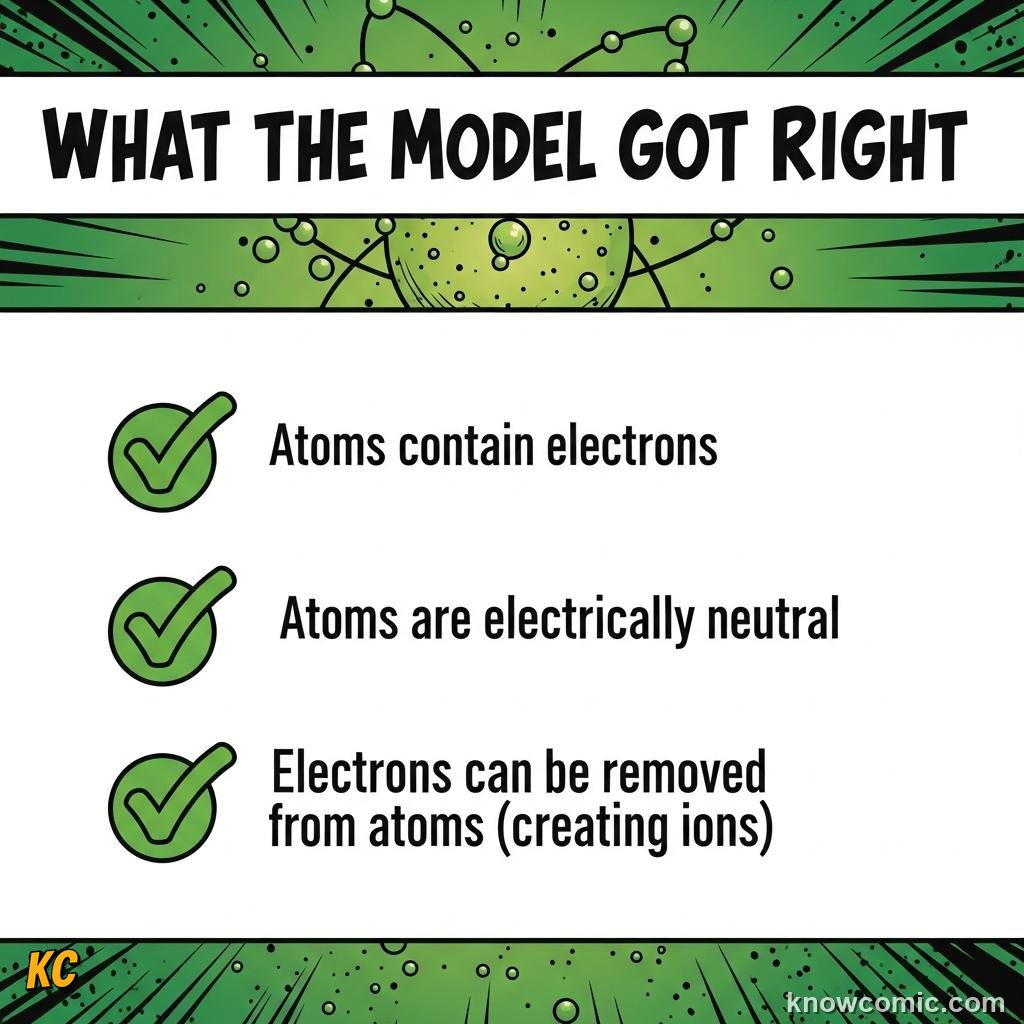
✅ Atoms contain electrons
✅ Atoms are electrically neutral
✅ Electrons can be removed from atoms
✅ Atoms are electrically neutral
✅ Electrons can be removed from atoms
❌ WHAT IT GOT WRONG
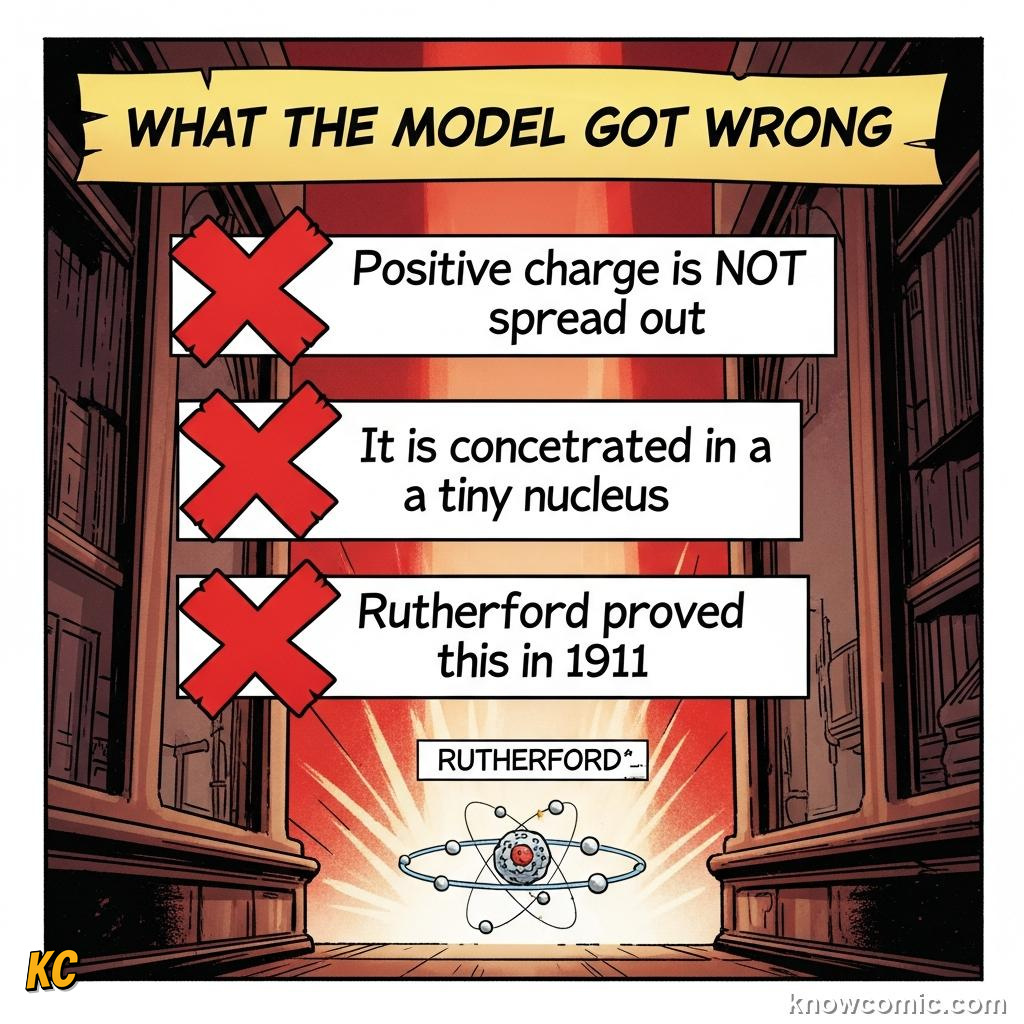
❌ Positive charge is NOT spread out
❌ It is concentrated in a tiny nucleus
🔬 Rutherford proved this in 1911
❌ It is concentrated in a tiny nucleus
🔬 Rutherford proved this in 1911
PAGE 5 OF 5 — ELECTRONS POWER OUR WORLD
FROM DISCOVERY TO DIGITAL REVOLUTION
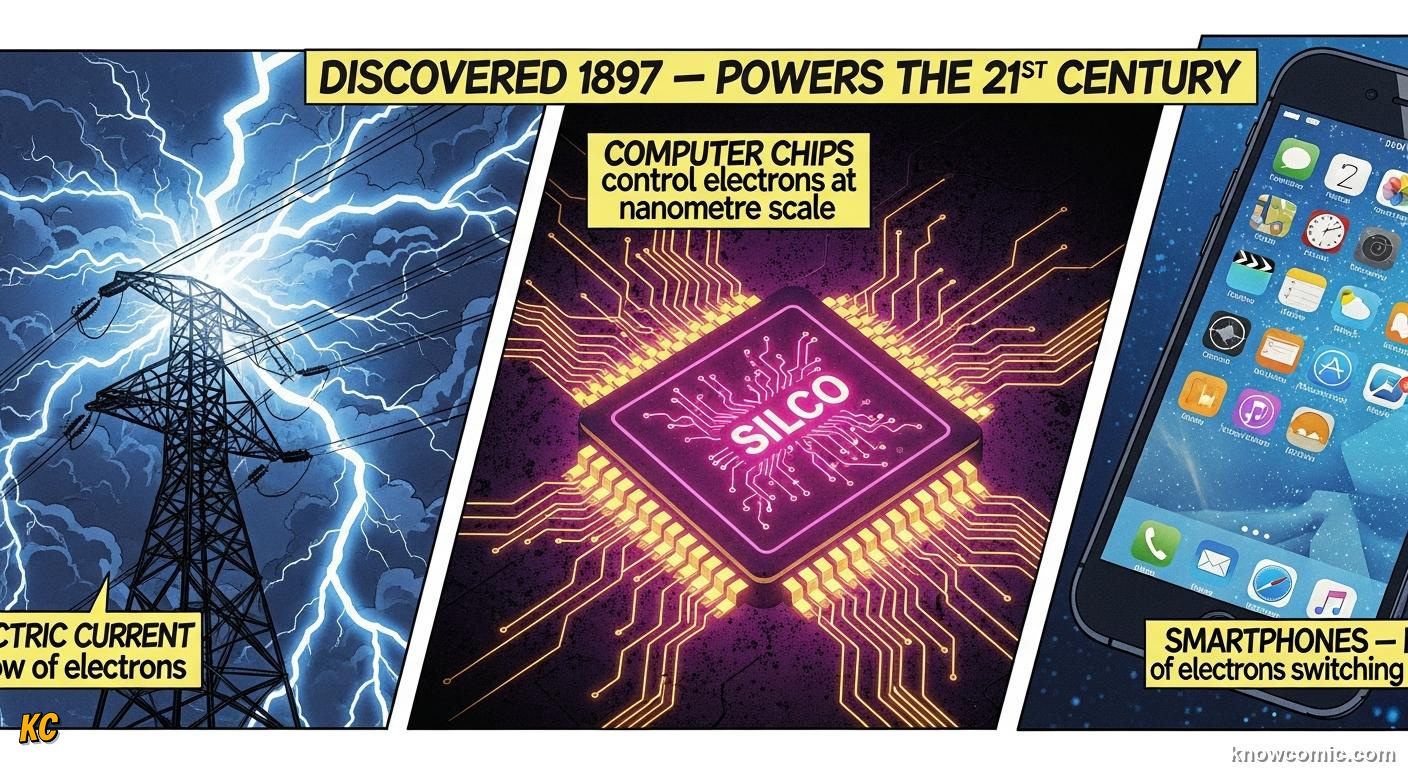
WHY ELECTRONS MATTER
Thomson's discovery of the electron in 1897 triggered one of the greatest technological revolutions in history. Electrons are responsible for all of chemistry — every chemical bond forms when atoms share or transfer electrons. Every electrical current is simply a flow of electrons through a conductor. The entire electronics industry — from light bulbs to smartphones to artificial intelligence — depends on our ability to control electrons. The cathode ray tube Thomson used became the television screen. Semiconductors control electrons in computer chips at nanometre scales. Without Thomson's tiny particle, none of the modern world would exist.
💡 ELECTRONS IN EVERYDAY LIFE
Electricity, chemical bonding, light from LEDs, data stored on hard drives, Wi-Fi signals — all rely on electron behaviour discovered by Thomson in 1897.
SPARK!
🔬 THOMSON'S LEGACY
1897 Thomson discovers electron
1906 Nobel Prize in Physics
1909 Millikan measures exact charge
1913 Bohr maps electron shells
1906 Nobel Prize in Physics
1909 Millikan measures exact charge
1913 Bohr maps electron shells
REMEMBER
⚡ KEY FACTS
Thomson discovered the electron in 1897 using cathode ray tubes. Electrons have a negative charge (−1) and are 1,836 times lighter than a proton. Thomson's plum pudding model was the first atomic model — later replaced by Rutherford's nuclear model.
✅ Cathode rays = streams of electrons
✅ Electrons are subatomic particles
✅ Charge = −1, Mass = tiny
✅ Plum pudding model — first attempt
✅ Electrons are subatomic particles
✅ Charge = −1, Mass = tiny
✅ Plum pudding model — first attempt
🧠 QUIZ TIME!
DISCOVERING ELECTRONS · 5 QUESTIONS
QUESTION 01
What apparatus did J.J. Thomson use to discover the electron in 1897?
QUESTION 02
What is the electric charge of an electron?
QUESTION 03
In Thomson's plum pudding model, what does the "pudding" (dough) represent?
QUESTION 04
How does the mass of an electron compare to the mass of a proton?
QUESTION 05
Which scientist first measured the exact charge of a single electron in 1909?
0/5
LOADING...