⚛️ THE ATOMIC IDEA
PAGE 1 OF 5 — EVERYTHING IS MADE OF ATOMS
THE SMALLEST UNIT OF MATTER
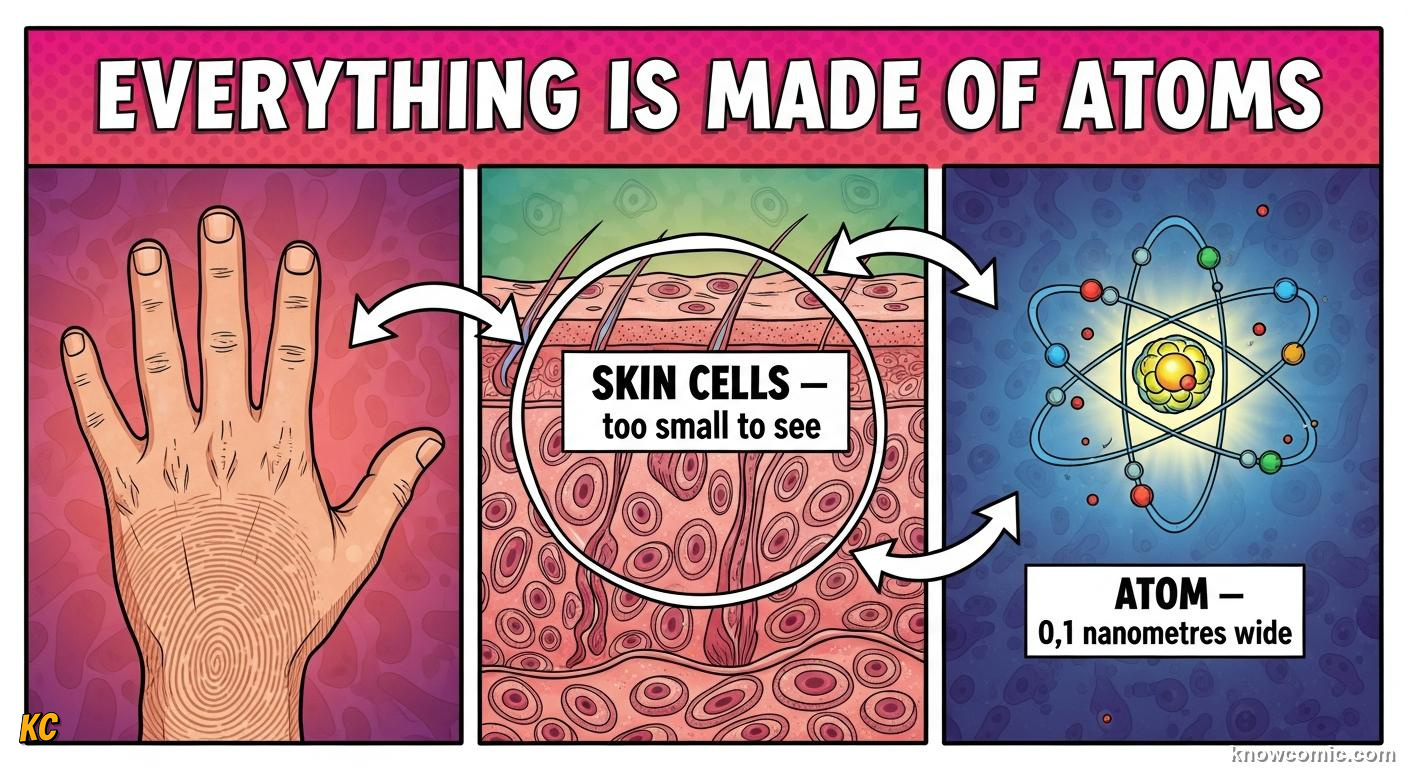
THE WORLD IS MADE OF TINY PARTICLES
Look at your hand. It looks solid. But zoom in far enough — more than a trillion times — and you find tiny, almost-empty spheres called atoms. Atoms are the fundamental building blocks of all matter in the universe. Every rock, every drop of water, every breath of air, every star in the sky is made entirely of atoms. The word "atom" comes from the ancient Greek atomos, meaning "uncuttable." The ancient Greeks were mostly right — atoms cannot be divided by chemical means.
🔬 HOW SMALL IS AN ATOM?
An atom is about 0.1 nanometres wide. One million atoms side by side would fit across a single human hair.
TINY!
400 BC — ANCIENT GREECE
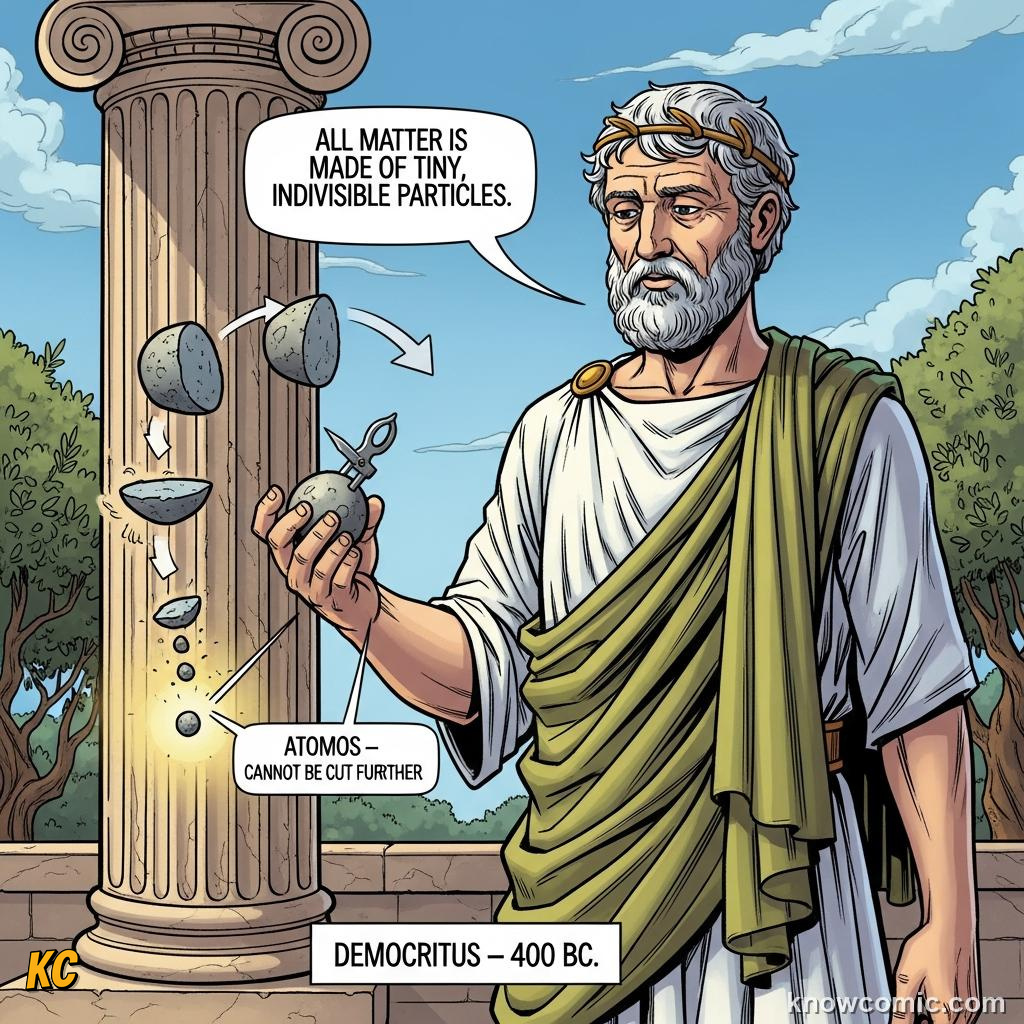
🏛️ Democritus named them "atomos"
⚛️ Matter is made of invisible particles
🌌 Empty space exists between all atoms
⚛️ Matter is made of invisible particles
🌌 Empty space exists between all atoms
ARISTOTLE DISAGREED
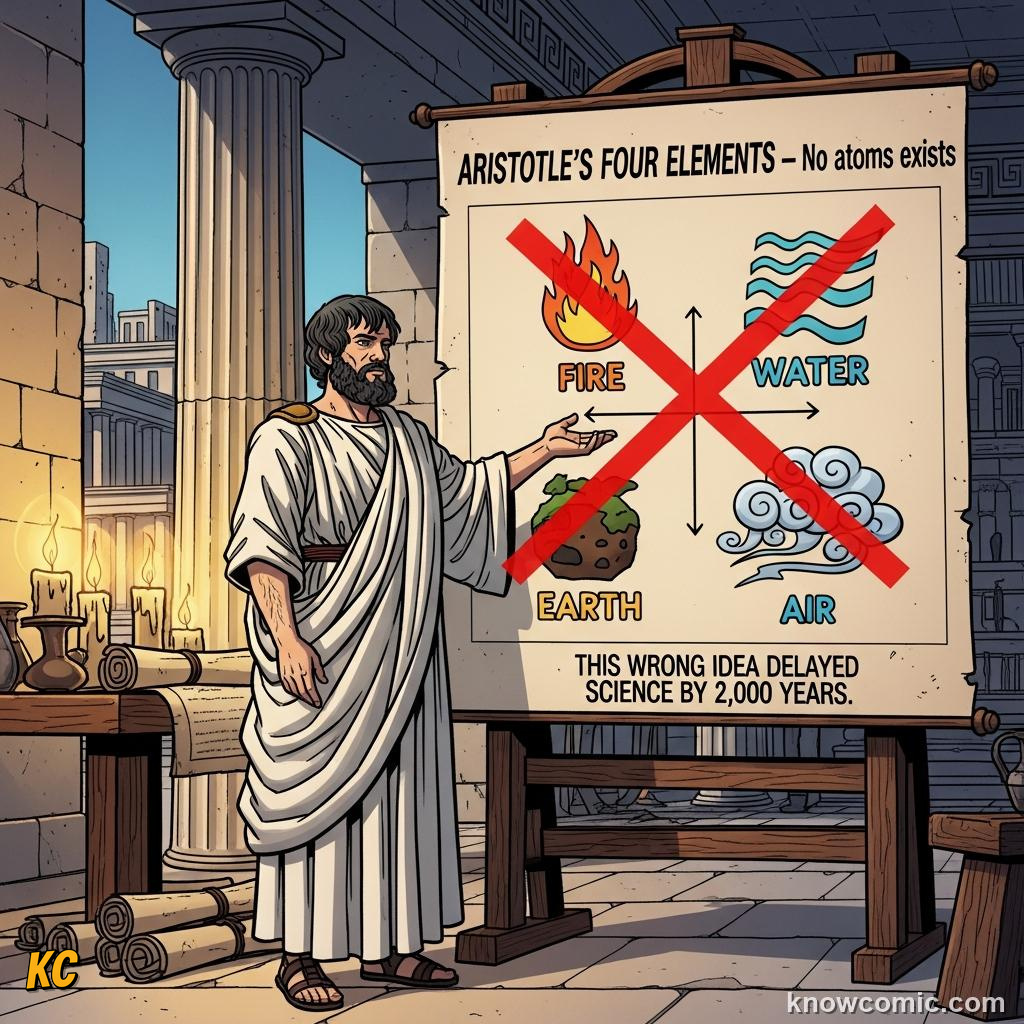
📜 Aristotle: matter = earth, water, fire, air
❌ Said atoms do NOT exist
⏳ His wrong idea lasted 2,000 years!
❌ Said atoms do NOT exist
⏳ His wrong idea lasted 2,000 years!
PAGE 2 OF 5 — JOHN DALTON'S ATOMIC THEORY, 1803
THE MAN WHO PROVED ATOMS EXIST
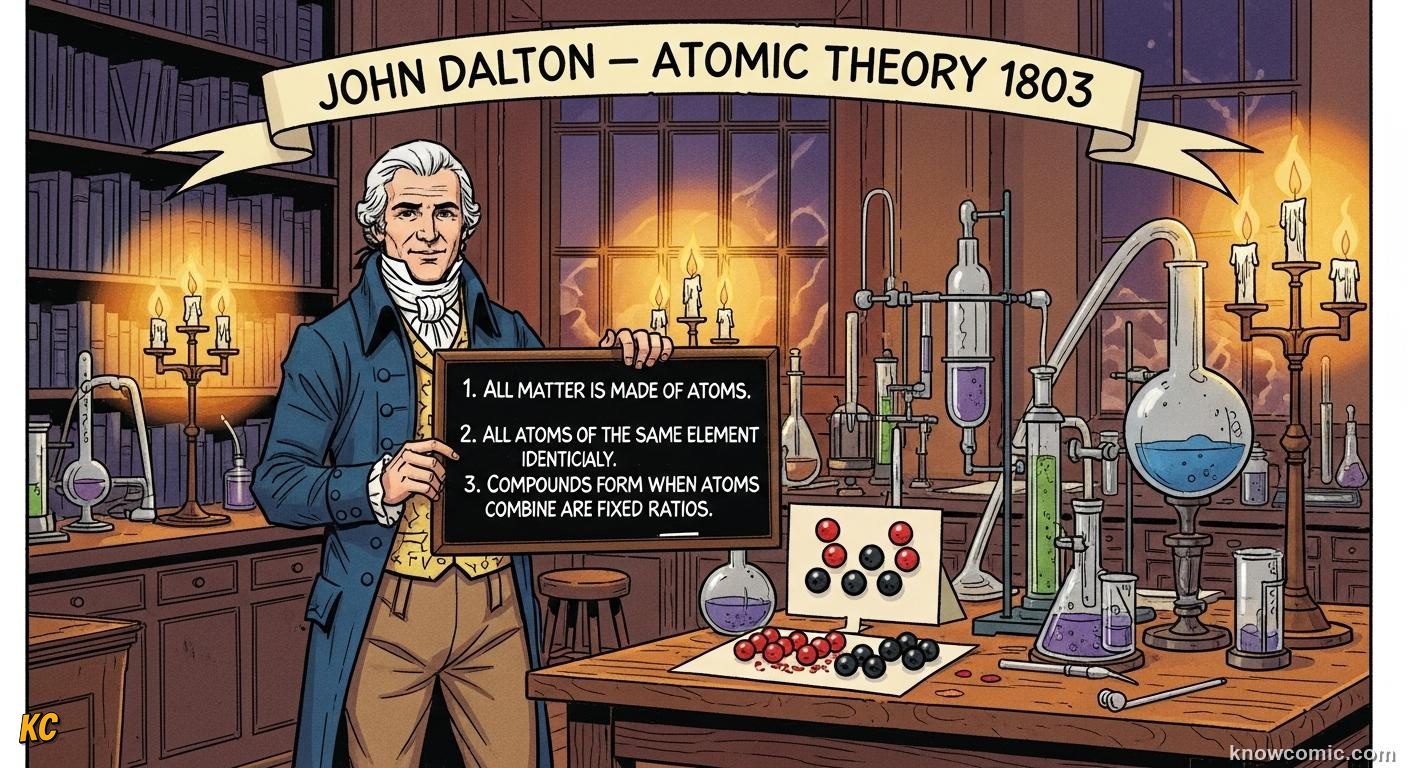
JOHN DALTON, 1803
In 1803, British chemist John Dalton published the first scientific Atomic Theory backed by experimental evidence. Dalton noticed that elements always combine in fixed ratios by mass. From this, he concluded that matter must be made of discrete, indivisible particles — atoms. He described atoms as tiny, solid billiard balls: indestructible and unique to each element. While later science proved atoms can be split, his core idea was correct: each element has its own unique type of atom, and atoms are never created or destroyed — only rearranged.
⚗️ DALTON'S KEY CLAIM
All matter is made of atoms. Atoms of the same element are identical. Compounds always combine in whole-number ratios.
EUREKA!
📌 POINT 1
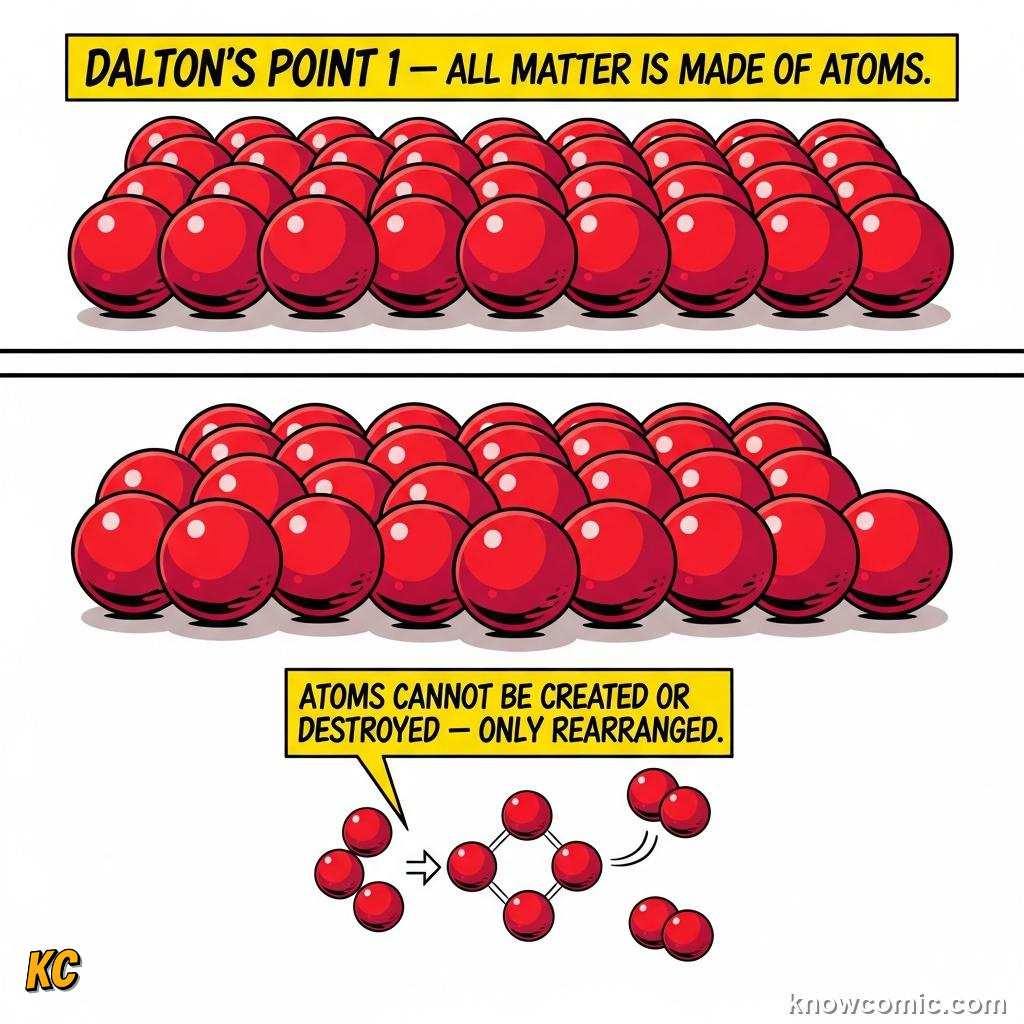
⚛️ All matter is made of atoms
🔒 Atoms are tiny and indivisible
♻️ Atoms cannot be created or destroyed
🔒 Atoms are tiny and indivisible
♻️ Atoms cannot be created or destroyed
📌 POINT 2
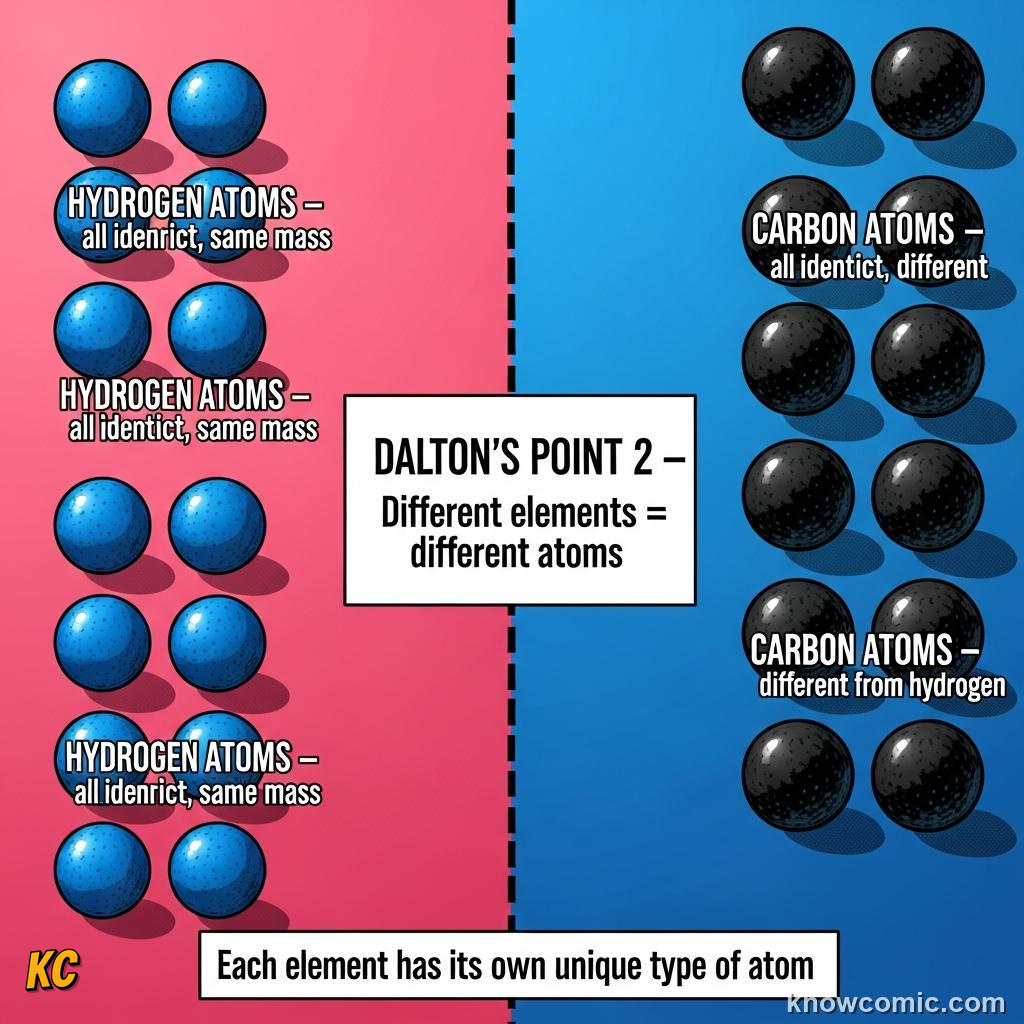
🟡 All atoms of the same element are identical
↔️ Same mass and same properties
🔴 Different elements = different atoms
↔️ Same mass and same properties
🔴 Different elements = different atoms
📌 POINT 3
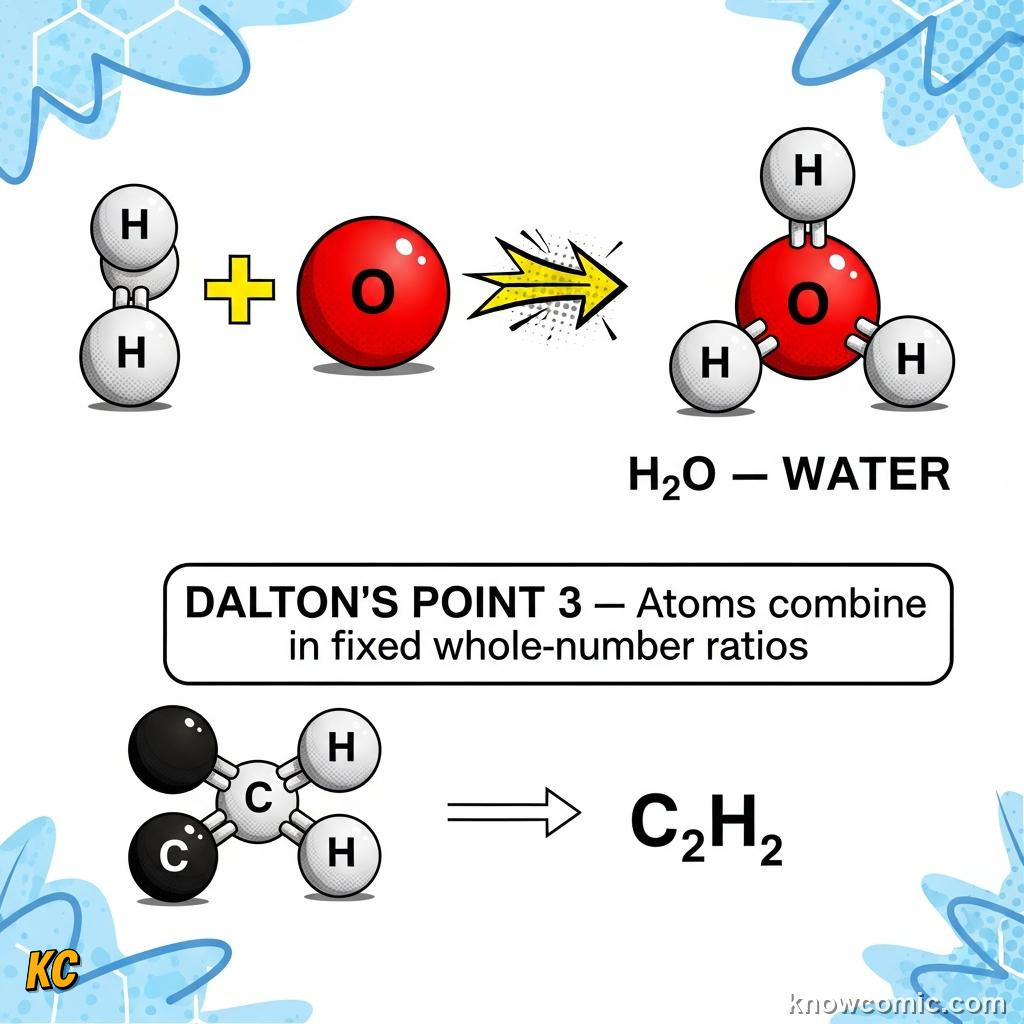
🔗 Compounds form when atoms combine
🔢 Always in fixed whole-number ratios
💧 Water: always 2 hydrogen + 1 oxygen
🔢 Always in fixed whole-number ratios
💧 Water: always 2 hydrogen + 1 oxygen
PAGE 3 OF 5 — INSIDE THE ATOM
THE PROTON
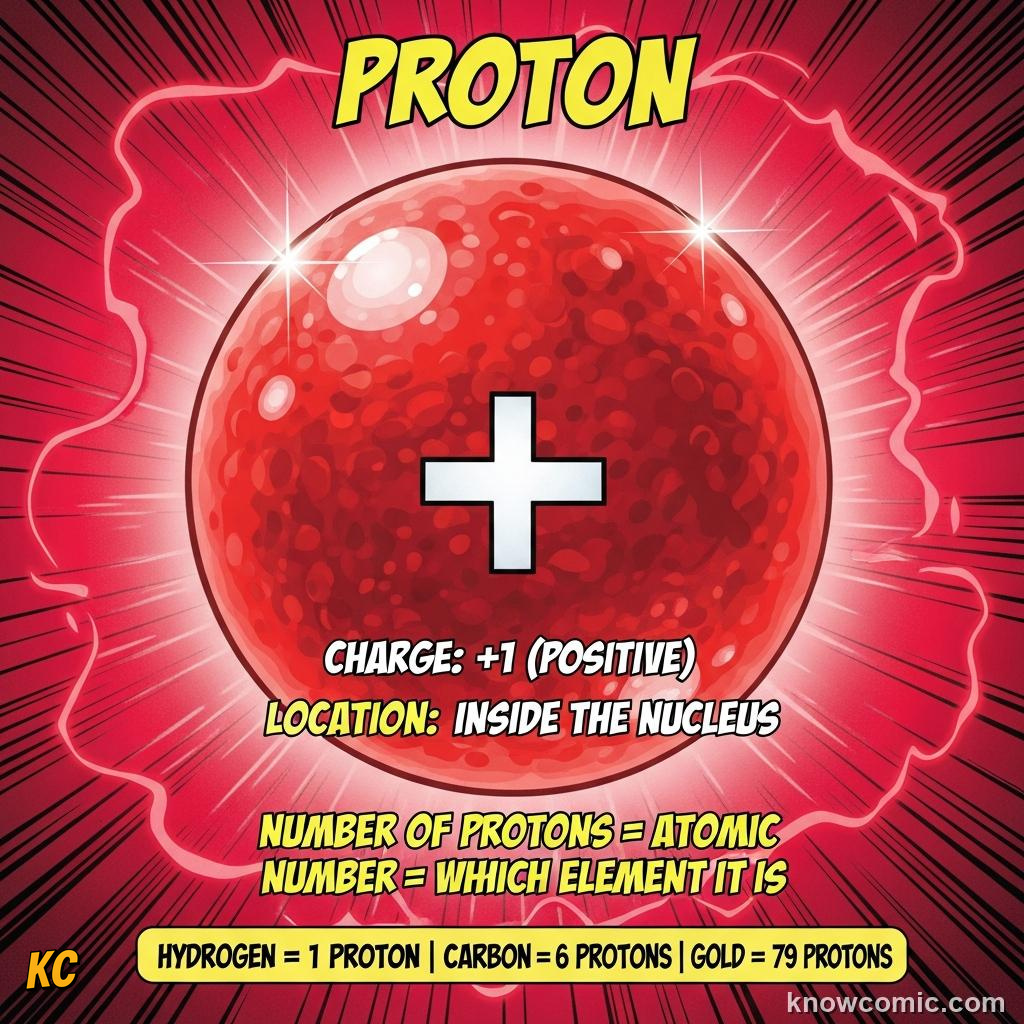
🔴 Proton: positive charge (+1)
🏠 Lives inside the nucleus
🔢 Number of protons = atomic number
🏠 Lives inside the nucleus
🔢 Number of protons = atomic number
NEUTRONS & ELECTRONS
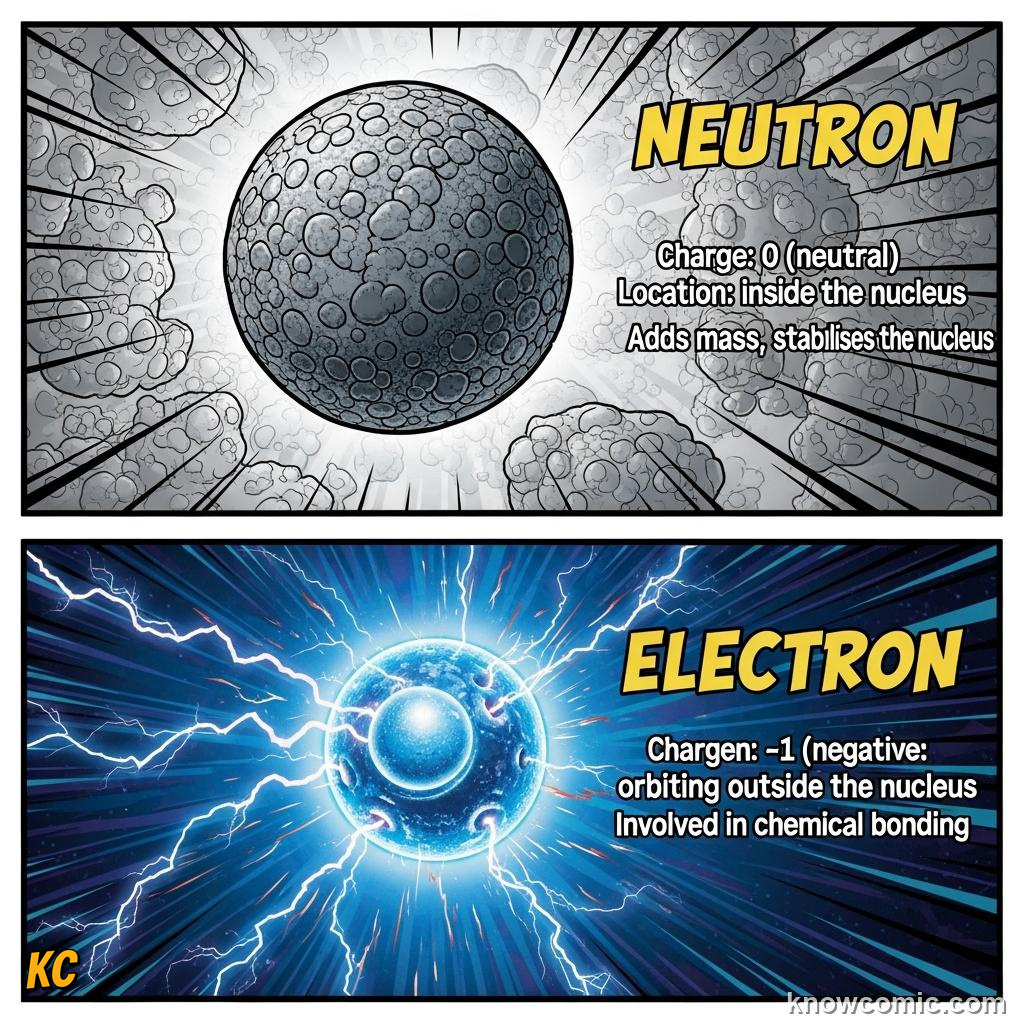
⚪ Neutron: no charge (0) — in nucleus
🔵 Electron: negative charge (−1)
☁️ Electrons orbit far outside the nucleus
🔵 Electron: negative charge (−1)
☁️ Electrons orbit far outside the nucleus
ATOMIC STRUCTURE
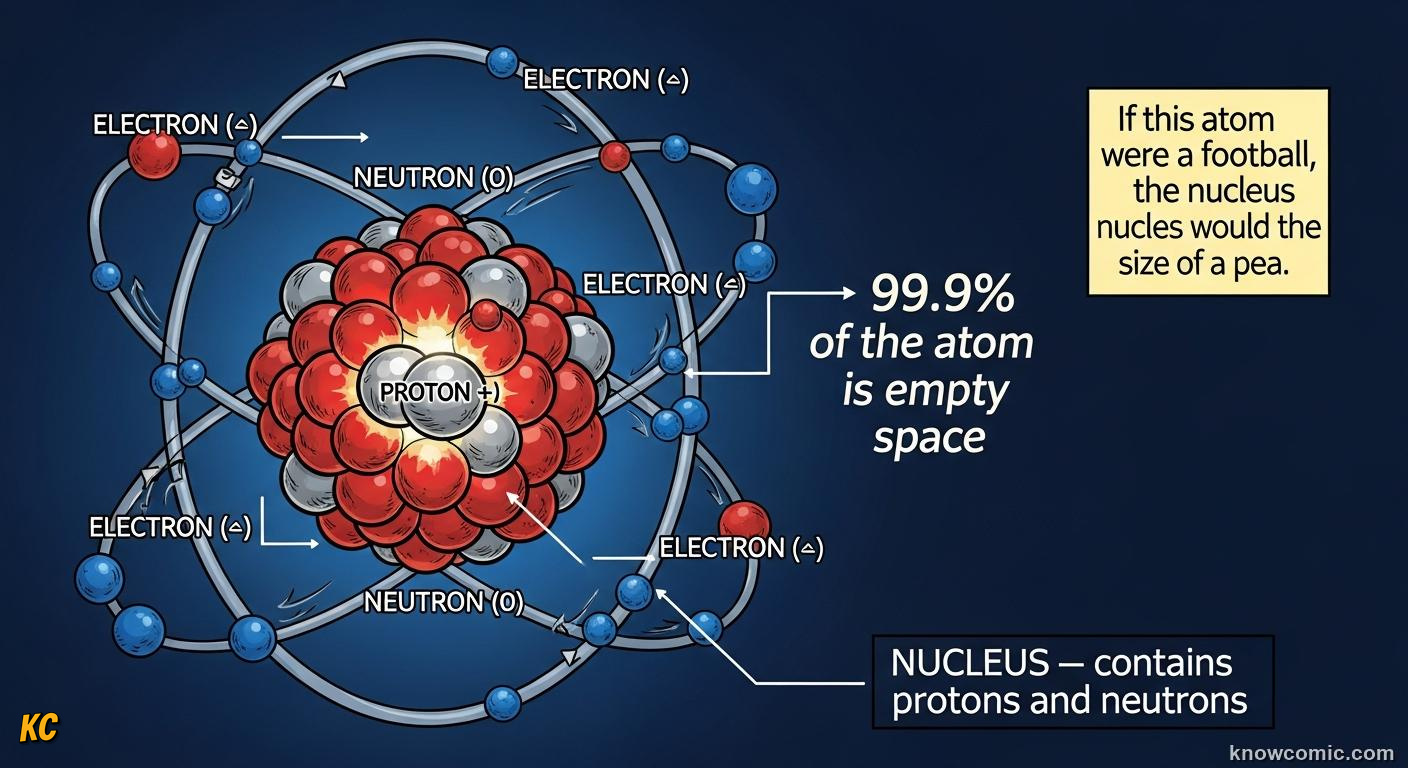
ATOMS HAVE THREE PARTS
Dalton thought atoms were solid and indivisible — later scientists discovered atoms have internal structure. Every atom has a tiny, dense nucleus at the centre containing positively charged protons and neutral neutrons. Surrounding the nucleus is a vast region of empty space where negatively charged electrons orbit at high speed. The number of protons defines what element the atom is — change the proton count and you change the element entirely. Hydrogen has 1 proton. Carbon has 6. Gold has 79.
⚛️ MIND-BLOWING FACT
99.9% of an atom is empty space. If an atom were the size of a football stadium, the nucleus would be the size of a pea at the centre.
NUCLEUS!
PAGE 4 OF 5 — ELEMENTS & THE PERIODIC TABLE
118 TYPES OF ATOM — ALL KNOWN MATTER
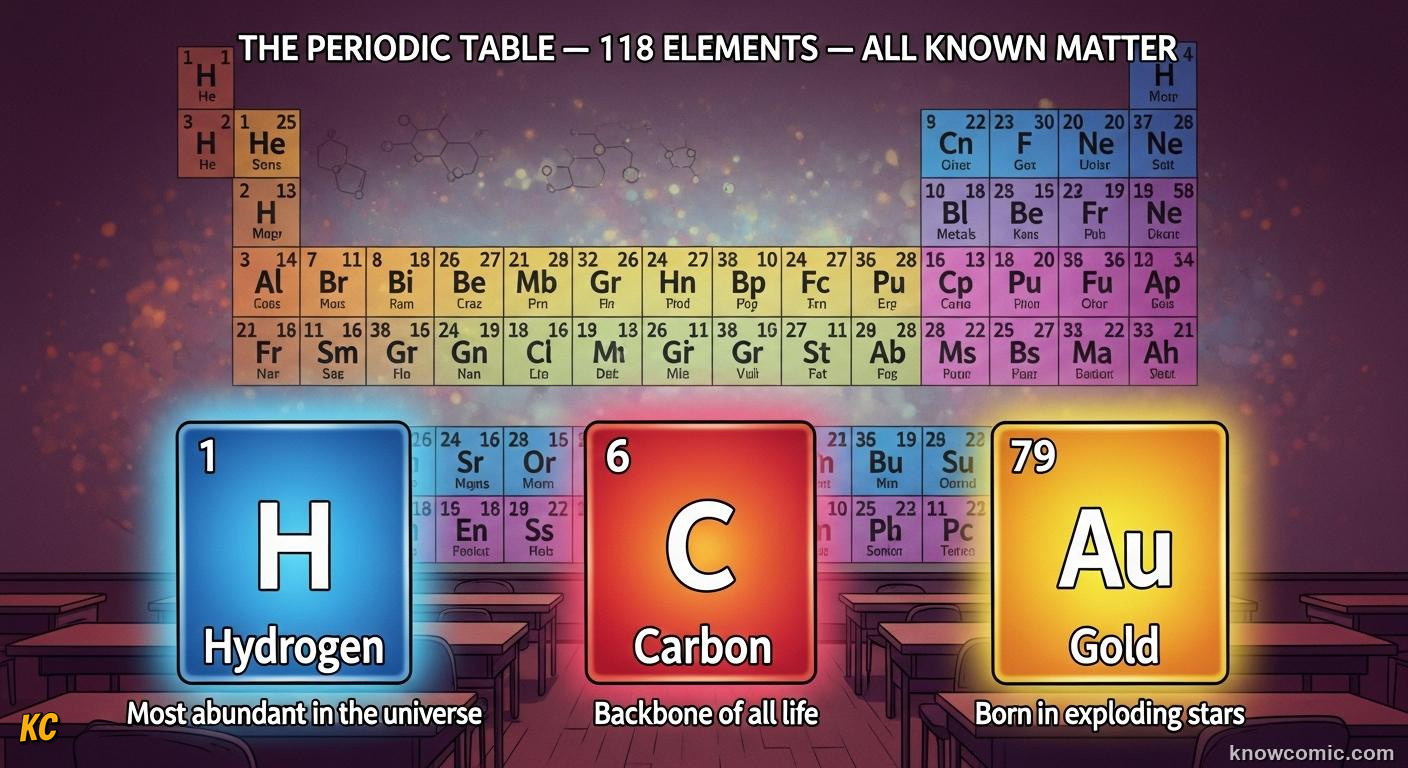
THE PERIODIC TABLE OF ELEMENTS
Every substance in the universe is made from just 118 different types of atom — the elements. In 1869, Russian chemist Dmitri Mendeleev arranged all known elements into a table ordered by atomic mass, revealing a stunning pattern: elements with similar properties appeared at regular intervals. Today we order elements by atomic number (proton count), and the table correctly predicts the properties of every element ever discovered. All the materials we use — steel, plastic, glass, medicine — are made by combining just these 118 types of atom.
📋 THE PERIODIC TABLE
118 elements. 94 occur naturally on Earth. Elements 95–118 are synthetic, made in laboratories. Element 118, oganesson, was first made in 2002.
ELEMENTS!
H — HYDROGEN
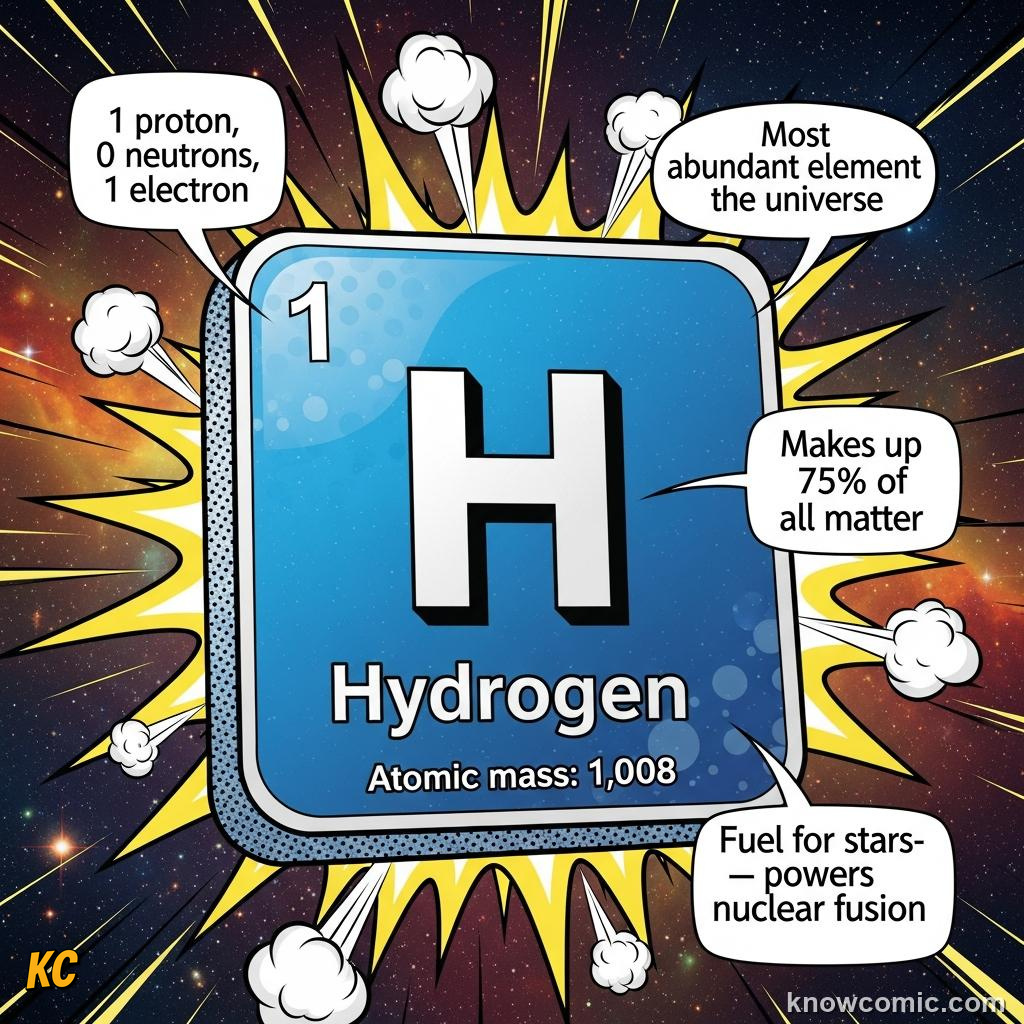
🔢 Atomic number: 1
⚡ 1 proton, 0 neutrons, 1 electron
🌌 Most abundant element in the universe
⚡ 1 proton, 0 neutrons, 1 electron
🌌 Most abundant element in the universe
C — CARBON
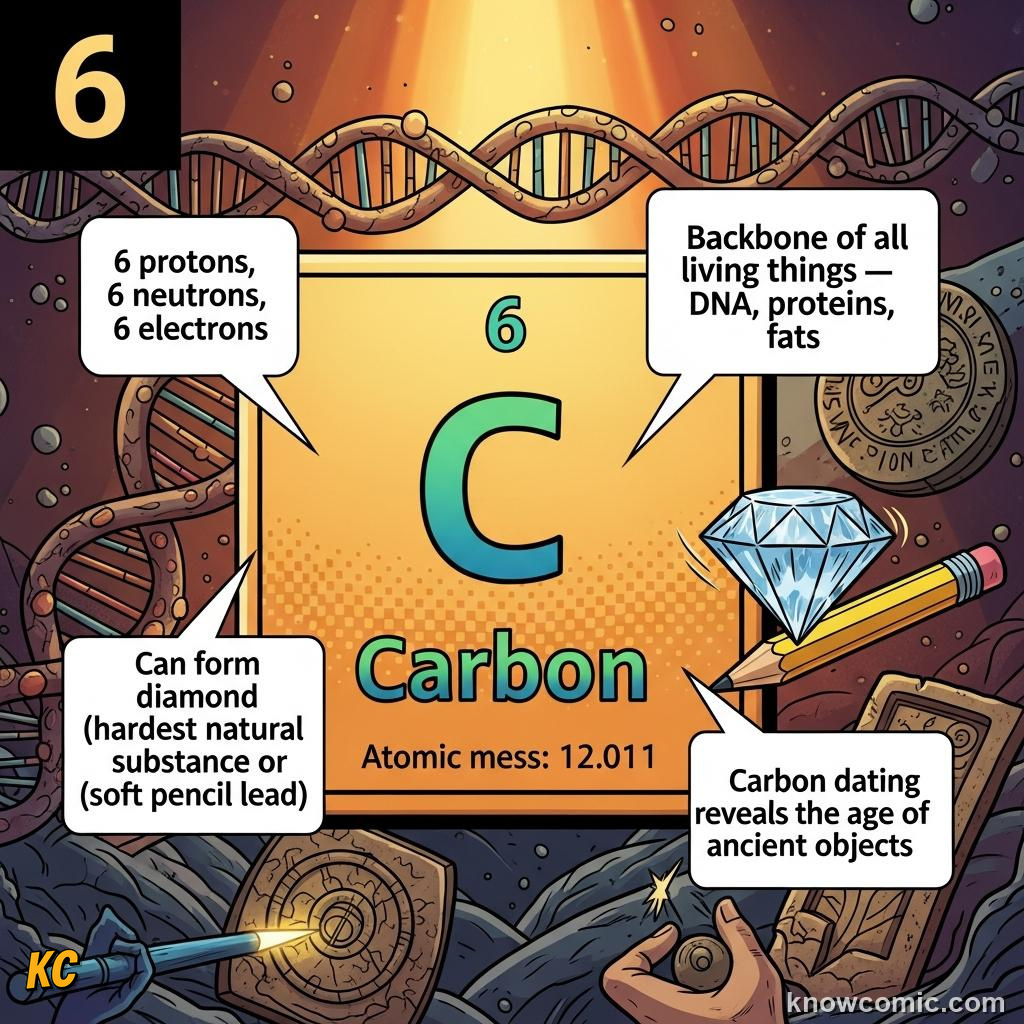
🔢 Atomic number: 6
⚡ 6 protons, 6 neutrons, 6 electrons
🧬 Backbone of all living things on Earth
⚡ 6 protons, 6 neutrons, 6 electrons
🧬 Backbone of all living things on Earth
Au — GOLD
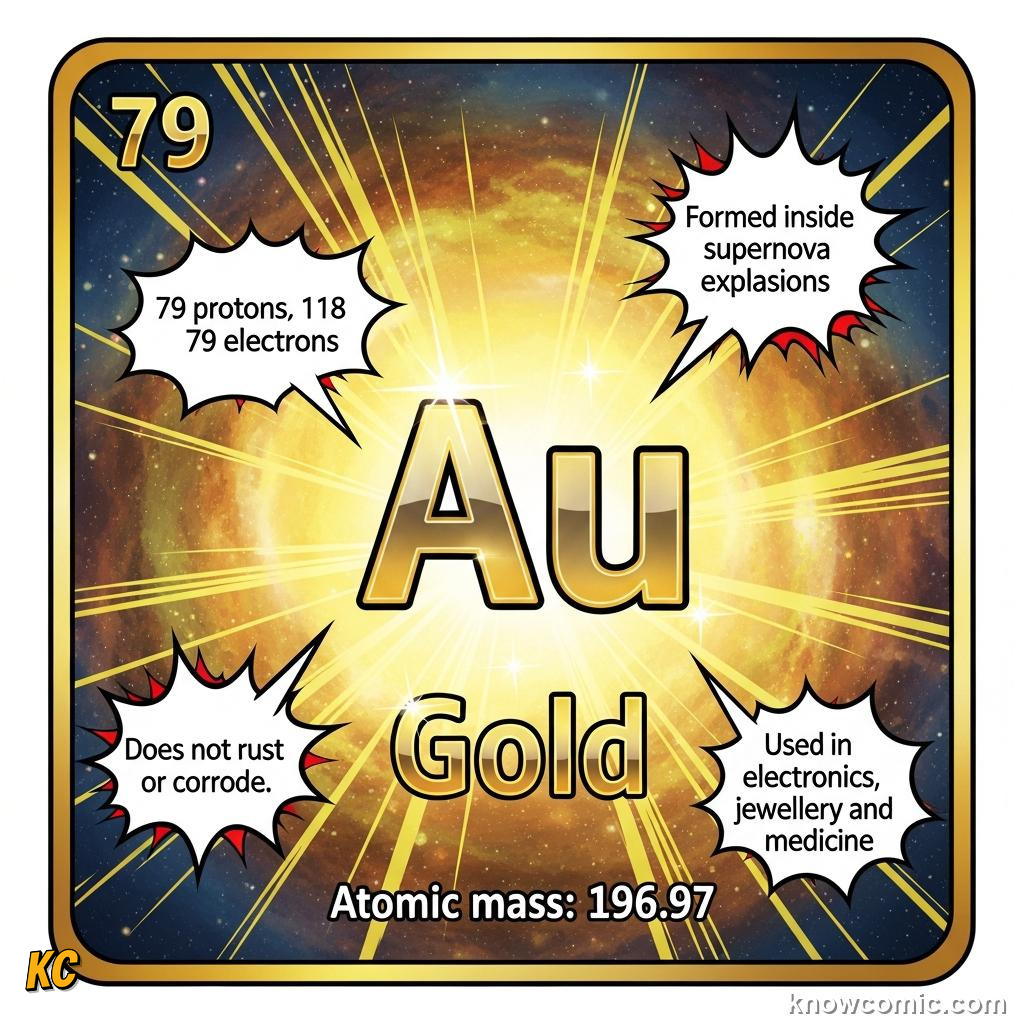
🔢 Atomic number: 79
⚡ 79 protons, 118 neutrons, 79 electrons
💥 Forged inside exploding stars (supernovae)
⚡ 79 protons, 118 neutrons, 79 electrons
💥 Forged inside exploding stars (supernovae)
PAGE 5 OF 5 — WHY THE ATOMIC IDEA CHANGED EVERYTHING
THE IDEA THAT BUILT MODERN SCIENCE
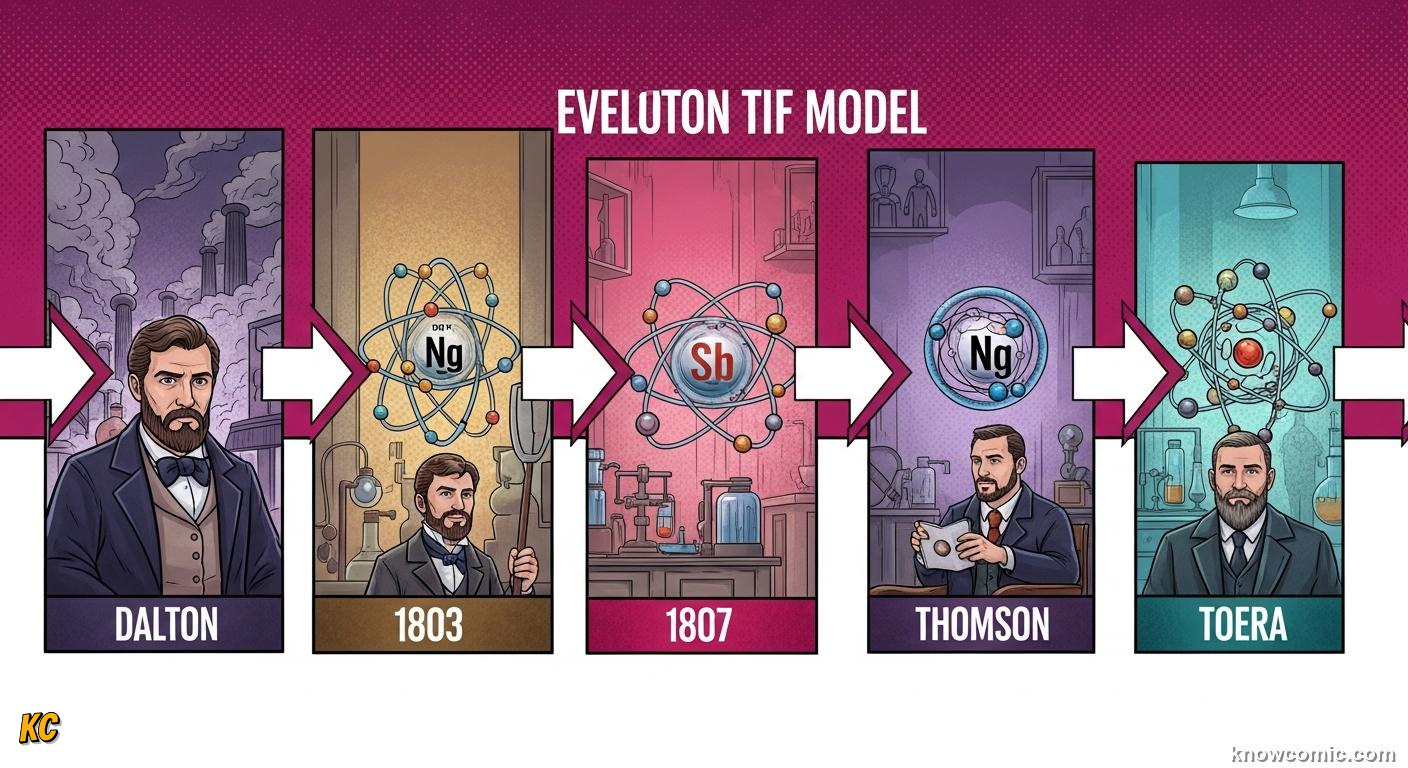
FROM DALTON TO QUANTUM CHEMISTRY
Dalton's Atomic Theory of 1803 triggered a scientific revolution. Once scientists accepted that matter is made of atoms, everything else followed. Mendeleev built the Periodic Table. Thomson discovered the electron inside atoms. Rutherford found the nucleus. Bohr mapped electron shells. Schrödinger described electron probability clouds. Each discovery refined the model — but Dalton's core idea held: atoms are the building blocks of matter. Today, atomic theory underpins chemistry, physics, biology and medicine. Every drug designed, every material engineered, every nuclear reaction — all based on understanding the atom.
🌟 DALTON'S LEGACY
Without Dalton's atomic theory there would be no periodic table, no quantum mechanics, and no modern medicine.
REVOLUTION!
⚛️ ATOM MODEL TIMELINE
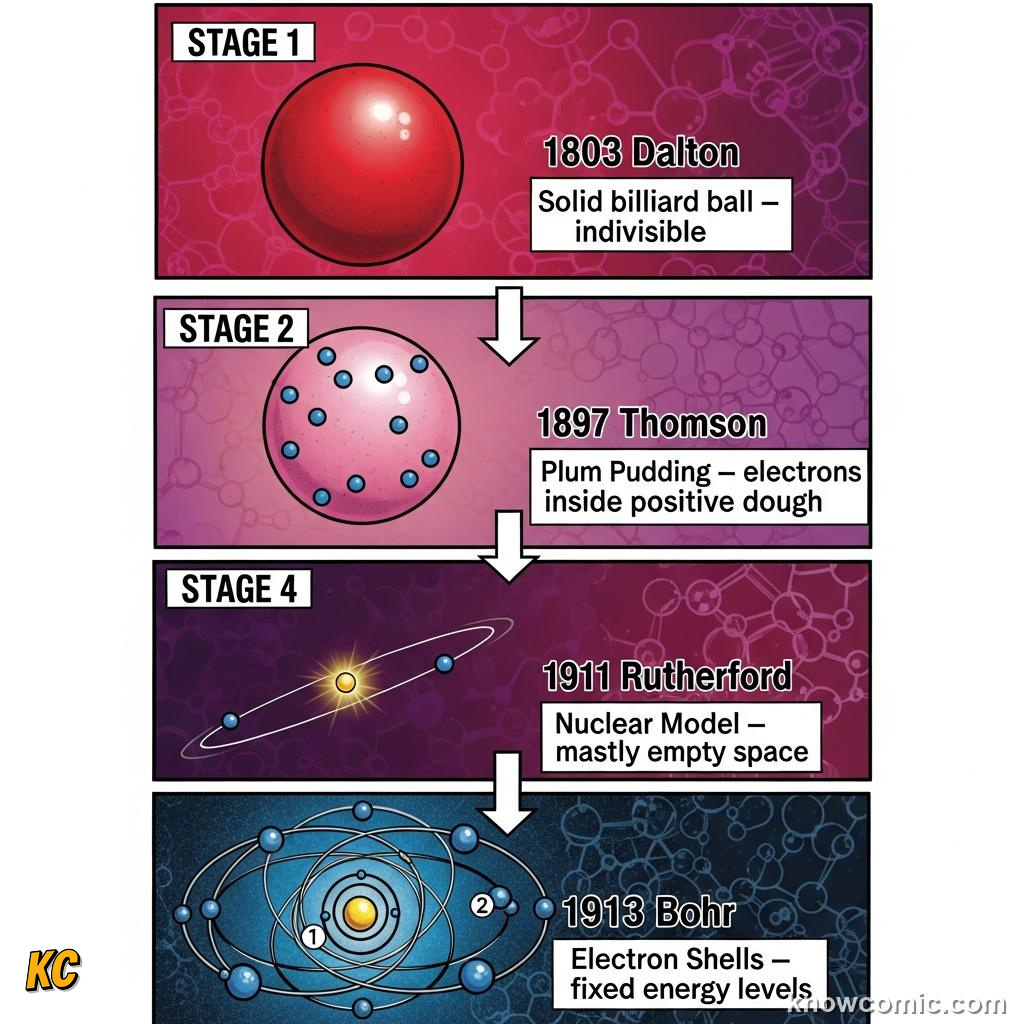
1803 Dalton: solid billiard ball
1897 Thomson: plum pudding model
1911 Rutherford: nuclear model
1913 Bohr: electron shells
1897 Thomson: plum pudding model
1911 Rutherford: nuclear model
1913 Bohr: electron shells
REMEMBER
⚛️ KEY FACTS
Atoms are the smallest units of matter. Dalton proved atoms exist in 1803. Every atom has protons, neutrons and electrons. There are 118 elements — each with its own unique type of atom.
✅ All matter = atoms
✅ Each element = unique atom type
✅ Atoms have nucleus + electrons
✅ 118 elements in the periodic table
✅ Each element = unique atom type
✅ Atoms have nucleus + electrons
✅ 118 elements in the periodic table
🧠 QUIZ TIME!
THE ATOMIC IDEA · 5 QUESTIONS
QUESTION 01
What does the ancient Greek word "atomos" mean?
QUESTION 02
Which scientist published the first scientific Atomic Theory based on experimental evidence in 1803?
QUESTION 03
What determines which element an atom belongs to?
QUESTION 04
Approximately how much of an atom is empty space?
QUESTION 05
How many different types of atom (elements) are currently known?
0/5
LOADING...