⚡ WORK, ENERGY & POWER
PAGE 1 OF 5 — WHAT IS WORK?
WORK DEFINED

FORCE × DISTANCE = WORK
In physics, "work" has a very precise meaning. Work is done when a force moves an object through a distance in the direction of the force. Push a box across a floor — you are doing work. Hold a heavy bag without moving — zero work, no matter how tired your arms feel! The formula is simple but powerful: Work (W) = Force (F) × Distance (d). The unit of work is the joule (J), named after physicist James Prescott Joule.
📐 THE FORMULA
W = F × d | Work = Force (N) × Distance (m) | Unit: Joule (J)
PUSH!
NO MOVEMENT = NO WORK

🧱 Pushing a fixed wall
→ No movement = 0 joules of work
💪 Effort ≠ physics work
→ No movement = 0 joules of work
💪 Effort ≠ physics work
ANGLE MATTERS

📐 Force must be in direction of motion
↗️ Angled force = less work done
✅ Parallel force = maximum work
↗️ Angled force = less work done
✅ Parallel force = maximum work
PAGE 2 OF 5 — FORMS OF ENERGY
ENERGY NEVER DISAPPEARS

THE FIRST LAW OF THERMODYNAMICS
Energy cannot be created or destroyed — only transformed from one form into another. This is the Law of Conservation of Energy, one of the most fundamental laws in all of science. Chemical energy in food becomes kinetic energy when you run. Electrical energy becomes light energy in a bulb. Gravitational potential energy becomes kinetic energy when you drop a ball. The total energy in the universe has been exactly the same since the Big Bang.
TRANSFORM!
⚡ KINETIC ENERGY

🏃 Energy of movement
KE = ½ × m × v²
🚗 Faster = much more energy
KE = ½ × m × v²
🚗 Faster = much more energy
🏔️ POTENTIAL ENERGY

🪨 Energy stored by position
PE = m × g × h
⬆️ Higher = more stored energy
PE = m × g × h
⬆️ Higher = more stored energy
🔥 THERMAL ENERGY

🌡️ Energy of vibrating particles
🔥 Heat always flows hot → cold
♨️ Friction creates thermal energy
🔥 Heat always flows hot → cold
♨️ Friction creates thermal energy
PAGE 3 OF 5 — CONSERVATION OF ENERGY
ROLLER COASTER: TOP

🎢 At the peak: maximum height
→ Gravitational potential energy is MAX
→ Kinetic energy is almost zero
→ Gravitational potential energy is MAX
→ Kinetic energy is almost zero
ROLLER COASTER: BOTTOM

⬇️ At the bottom: minimum height
→ Potential energy converted to speed
→ Kinetic energy is MAX
→ Potential energy converted to speed
→ Kinetic energy is MAX
ENERGY CONSERVATION LAW

ENERGY JUST CHANGES FORM
At the top of a roller coaster, all energy is gravitational potential energy. As the car plunges down, potential energy converts to kinetic energy — speed increases as height drops. At the bottom, kinetic energy is at its maximum. This swap between potential and kinetic energy happens constantly in pendulums, bouncing balls, and swings. The total energy at every point remains equal — nothing is lost, only transformed.
🎯 KEY EQUATION
Total Energy = Kinetic Energy + Potential Energy (always constant)
CONSERVED!
PAGE 4 OF 5 — POWER: THE RATE OF WORK
POWER DEFINED

HOW FAST IS WORK DONE?
Two people carry the same box up a staircase. One takes 10 seconds. The other takes 60 seconds. Both do the same amount of work — but the faster person uses more power. Power is the rate at which work is done: Power (P) = Work (W) ÷ Time (t). The unit of power is the watt (W), named after James Watt, the inventor who transformed the steam engine. One watt equals one joule of work done per second. A 60-watt light bulb converts 60 joules of electrical energy into light and heat every single second.
⚡ THE FORMULA
P = W ÷ t | Power = Work (J) ÷ Time (s) | Unit: Watt (W)
WATTS!
💡 LIGHT BULBS

💡 60 W bulb = 60 J per second
🌿 LED uses 8 W for same light
✅ Less watts = more efficient
🌿 LED uses 8 W for same light
✅ Less watts = more efficient
🏃 ATHLETE POWER
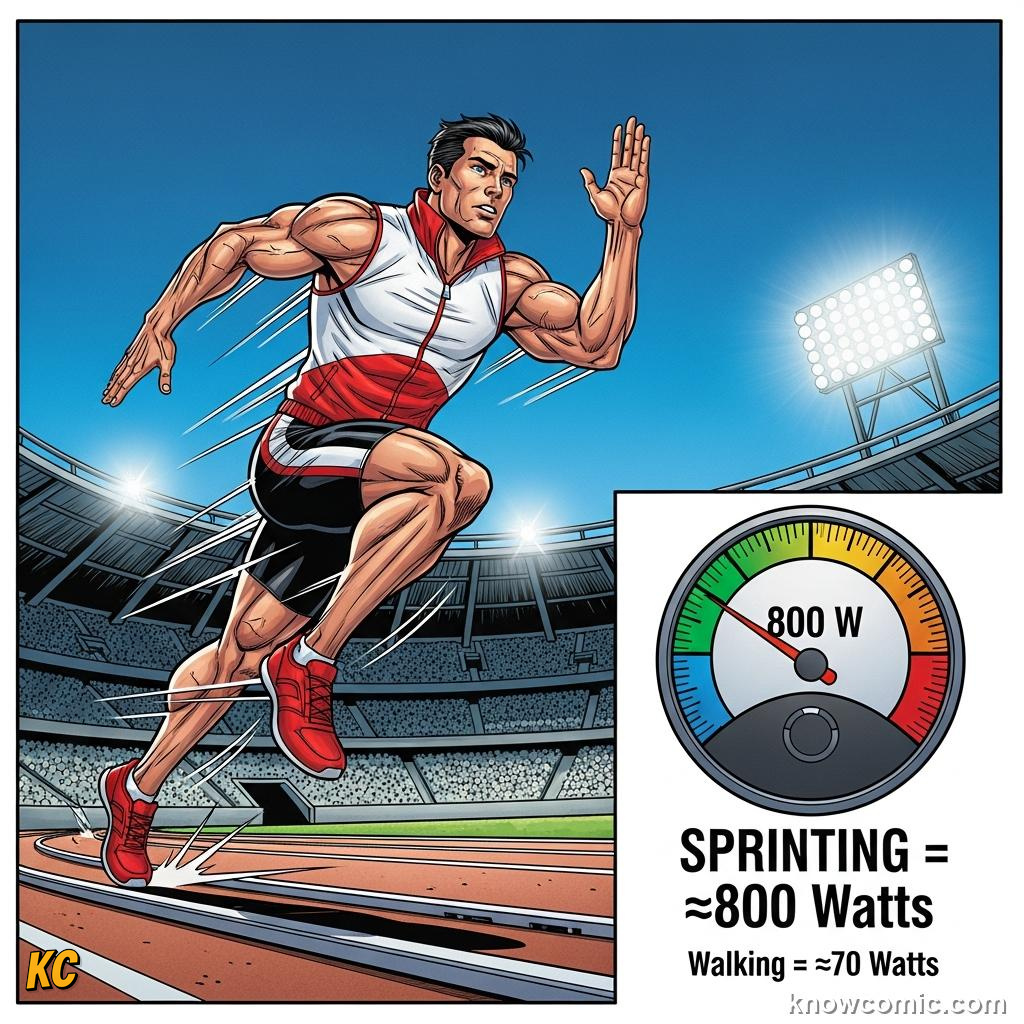
🏃 Sprint: ~800 watts of power
🚶 Walk: ~70 watts of power
💪 More speed = more power output
🚶 Walk: ~70 watts of power
💪 More speed = more power output
🏭 MACHINE POWER

🏭 Electric motor: thousands of watts
🚂 Steam locomotive: ~1 million watts
🚀 Rocket engine: billions of watts!
🚂 Steam locomotive: ~1 million watts
🚀 Rocket engine: billions of watts!
PAGE 5 OF 5 — ENERGY IN THE REAL WORLD
ENERGY'S GREAT JOURNEY

FROM THE SUN TO YOUR SCREEN
All energy on Earth originally comes from the Sun. Sunlight hits plants — photosynthesis converts light energy into chemical energy stored in food. You eat food — your body converts chemical energy into kinetic energy and thermal energy. Fossil fuels are ancient stores of chemical energy from sunlight millions of years ago. Power stations convert chemical or nuclear energy into electrical energy, which travels through cables into your home. Every screen, heater, and engine is an energy transformer.
☀️ ENERGY CHAIN
Sun → Plants (chemical) → Food → Body (kinetic + heat) → Motion
POWER!
☀️ RENEWABLE ENERGY

☀️ Solar panels: light → electrical
💨 Wind turbines: kinetic → electrical
🌊 Hydroelectric: potential → electrical
💨 Wind turbines: kinetic → electrical
🌊 Hydroelectric: potential → electrical
💡 WHAT YOU LEARNED
⚡ KEY FACTS
Work = Force × Distance. Energy transforms but is never destroyed. Power = Work ÷ Time. The watt measures power. All Earth's energy comes from the Sun.
✅ W = F × d (joules)
✅ Energy is always conserved
✅ P = W ÷ t (watts)
✅ 1 watt = 1 joule per second
✅ Energy is always conserved
✅ P = W ÷ t (watts)
✅ 1 watt = 1 joule per second
🧠 QUIZ TIME!
WORK, ENERGY & POWER · 5 QUESTIONS
QUESTION 01
What is the correct formula for work in physics?
QUESTION 02
A person pushes a wall for an hour but the wall doesn't move. How much work have they done?
QUESTION 03
What does the Law of Conservation of Energy state?
QUESTION 04
What is the unit of power, and what does it equal?
QUESTION 05
A roller coaster car sits at the top of the highest point. Which energy is at its maximum?
0/5
LOADING...